

The 10 Things a Feeding Therapist Tells Every Parent
After working with hundreds of families, we notice something. The same handful of truths come up again and again, in session after session, with parent after parent. They are the things we find ourselves saying at almost every table.
So here they are, gathered in one place. Ten things a feeding therapist tells every parent, and the reasons behind each one. If you are in the thick of feeding worry right now, this is the list we would want you to keep.
The First Five
These are the ones that reframe how you see your child and yourself at the table.
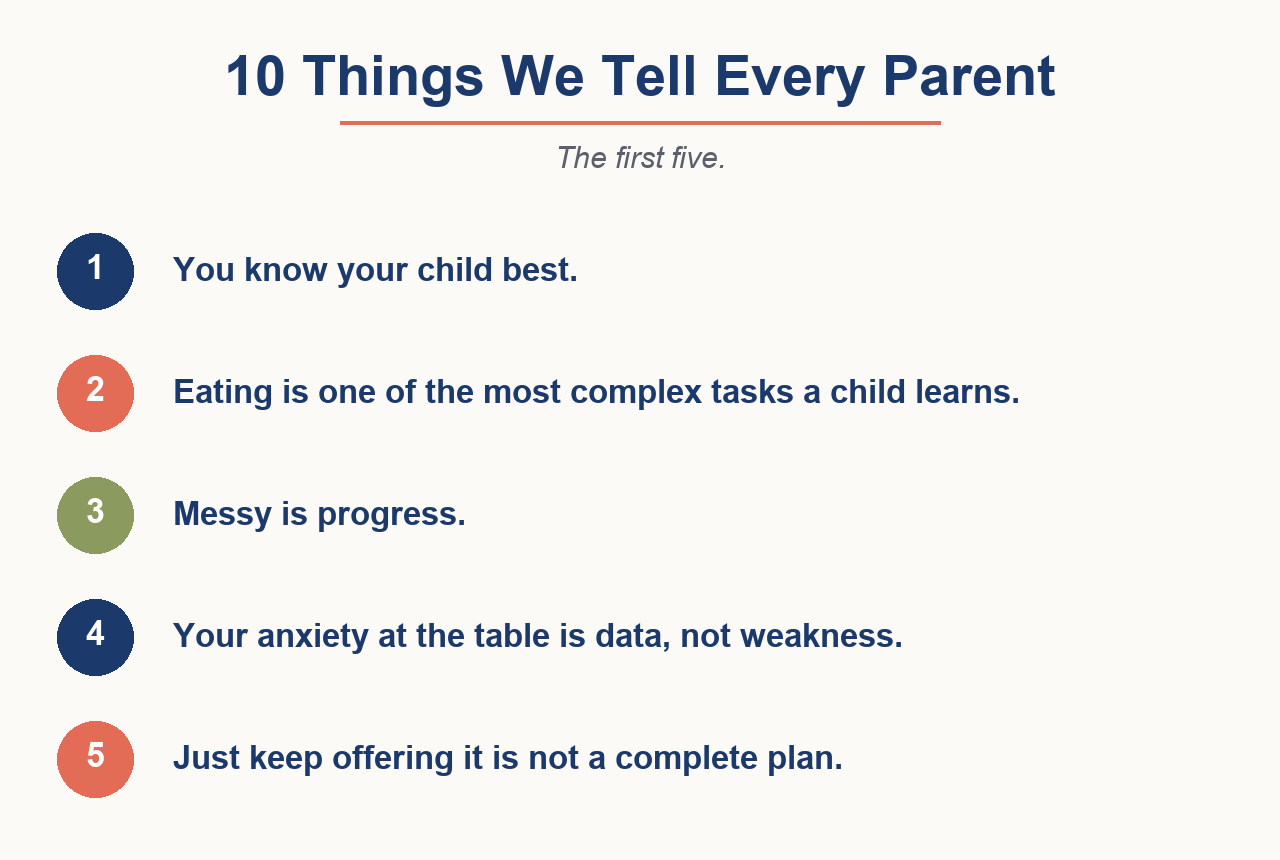
1. You Know Your Child Best
You are with your child every single day. If your gut says something is off, that instinct is data worth acting on, not worry to be waved away. Trust it enough to ask questions.
2. Eating Is One of the Most Complex Tasks a Child Learns
Eating uses the mouth, the sensory system, motor coordination, posture, and a calm nervous system, all at once. When you see how much has to go right, a struggle stops looking like defiance and starts looking like a skill still under construction.
3. Messy Is Progress
A child who is touching, squishing, and wearing their food is a child who is learning that food is safe. The mess is not a setback to clean up. It is the work happening in front of you.
4. Your Anxiety at the Table Is Data, Not Weakness
Your worry is not a character flaw. It is information about how hard this has been. Naming it and managing it, rather than hiding it, is part of what makes mealtimes calmer for your child.
5. "Just Keep Offering It" Is Not a Complete Plan
Exposure matters, but only without pressure and only once you understand why a child is refusing. Offering the same threatening food fifty more times, with no change to why it feels threatening, usually deepens the avoidance.
The Next Five
These are the ones that tell you what to do, and remind you that it is not too late.
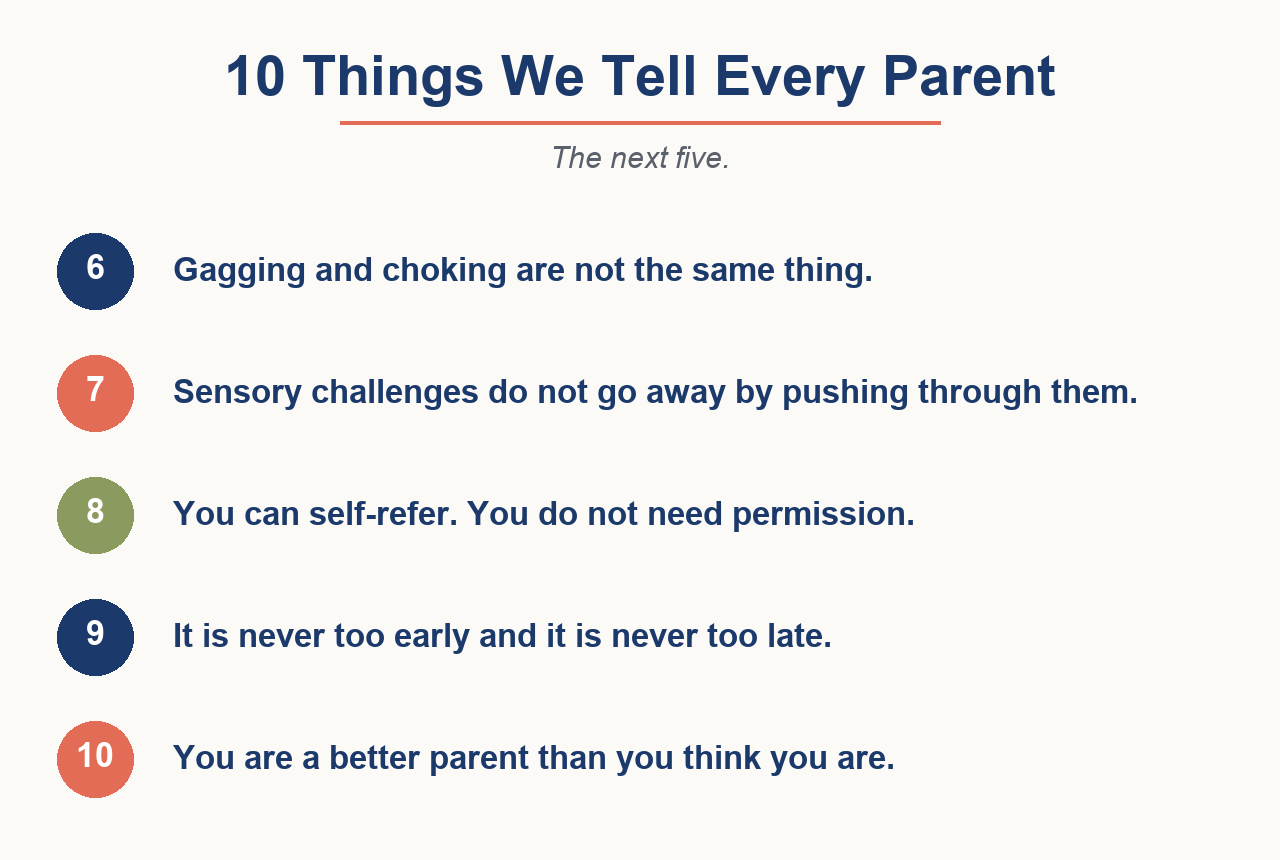
6. Gagging and Choking Are Not the Same Thing
Gagging is loud and protective, a normal part of learning to eat. Choking is silent and an emergency. Knowing the difference calms the fear that so often runs mealtimes.
7. Sensory Challenges Don't Go Away by Pushing Through Them
You cannot force a sensitive nervous system to stop being sensitive. Sensory challenges ease through safety and gradual support, not through pressure, and pushing usually makes them dig in.
8. You Can Self-Refer. You Don't Need Permission
In Texas you can seek a feeding evaluation without waiting for a doctor's referral. If your gut says it is time, you are allowed to act on that directly.
9. It's Never Too Early and It's Never Too Late
Early support is powerful, and later support still works. Whether your child is six months or six years, there is a helpful next step, so the age is never a reason to wait or to give up.
10. You're a Better Parent Than You Think You Are
If you are reading a list like this, you are already paying attention, already advocating, already trying. That is exactly what your child needs, and it counts for far more than you give yourself credit for.
Why These Ten Come Up Every Time
None of these is a clever trick. They are the quiet truths underneath almost every feeding difficulty we see, and they tend to be the things parents were never told.
Most of the families we work with arrive carrying a lot of guilt and a lot of conflicting advice. Nearly all of it lifts a little when these ten land. Feeding struggles are rarely about a stubborn child or a failing parent. They are about a complex skill, a sensitive system, and a table that needs to feel safe.
Frequently Asked Questions
My child is older. Is it really not too late?
It is not. Feeding skills can be built at many ages, and older children make real progress with the right support. Earlier is easier, but later is still very much worth doing.
How do I stop feeling guilty about my child's eating?
Start by knowing that feeding difficulties are not caused by bad parenting. They come from sensory, motor, and medical factors outside your control. You did not cause this, and you can help change it.
Which of these ten matters most?
They work together, but if we had to pick, it would be the first: you know your child best. Almost everything else follows from trusting that instinct enough to ask for help.
What is the first step if something on this list hit home?
A feeding evaluation. It is a calm, honest look at what is going on and what would help, and in Texas you can arrange one yourself without a referral.
Keep This List Close
If mealtimes have been heavy lately, we hope one of these ten gave you a breath. You are not failing, and you are not alone, and there is almost always a gentle next step.
Our team works with families across Houston and Bellaire, and we would be glad to be the ones who take a proper look with you.
Book a consultation with us and we will start with the first thing on the list: you know your child best.
For more free guidance, visit thelittleeaters.com/FreeDownloads.
Written by The Little Eaters & Talkers Team, a group of pediatric feeding and speech specialists based in Bellaire, TX. We help infants and toddlers navigate feeding challenges, sensory food aversions, and speech development so mealtimes can feel easier for the whole family.