
Baby-Led Weaning vs. Purees: What a Feeding Therapist Actually Recommends
Ask about baby-led weaning in any parent group and you'll get strong opinions on both sides. BLW advocates will tell you purees are developmental regression. Puree advocates will tell you BLW is a choking hazard.
The truth is less dramatic than either camp suggests — and the best answer for your baby is probably not what the internet says.
What Each Approach Actually Involves
Baby-led weaning (BLW)skips purees and spoon-feeding entirely. Starting around 6 months, babies are offered soft, appropriately sized pieces of food and encouraged to self-feed.
Puree-based starting begins with smooth purées on a spoon, gradually progressing to thicker textures, then mashed, then soft lumpy, then soft pieces over several months.
A combined (hybrid) approach uses both — some spoon-fed purees alongside some soft finger foods from the start. This is what most families I work with end up doing.
What the Research Actually Says
There's good news for both camps: neither approach is clearly superior for most healthy babies.
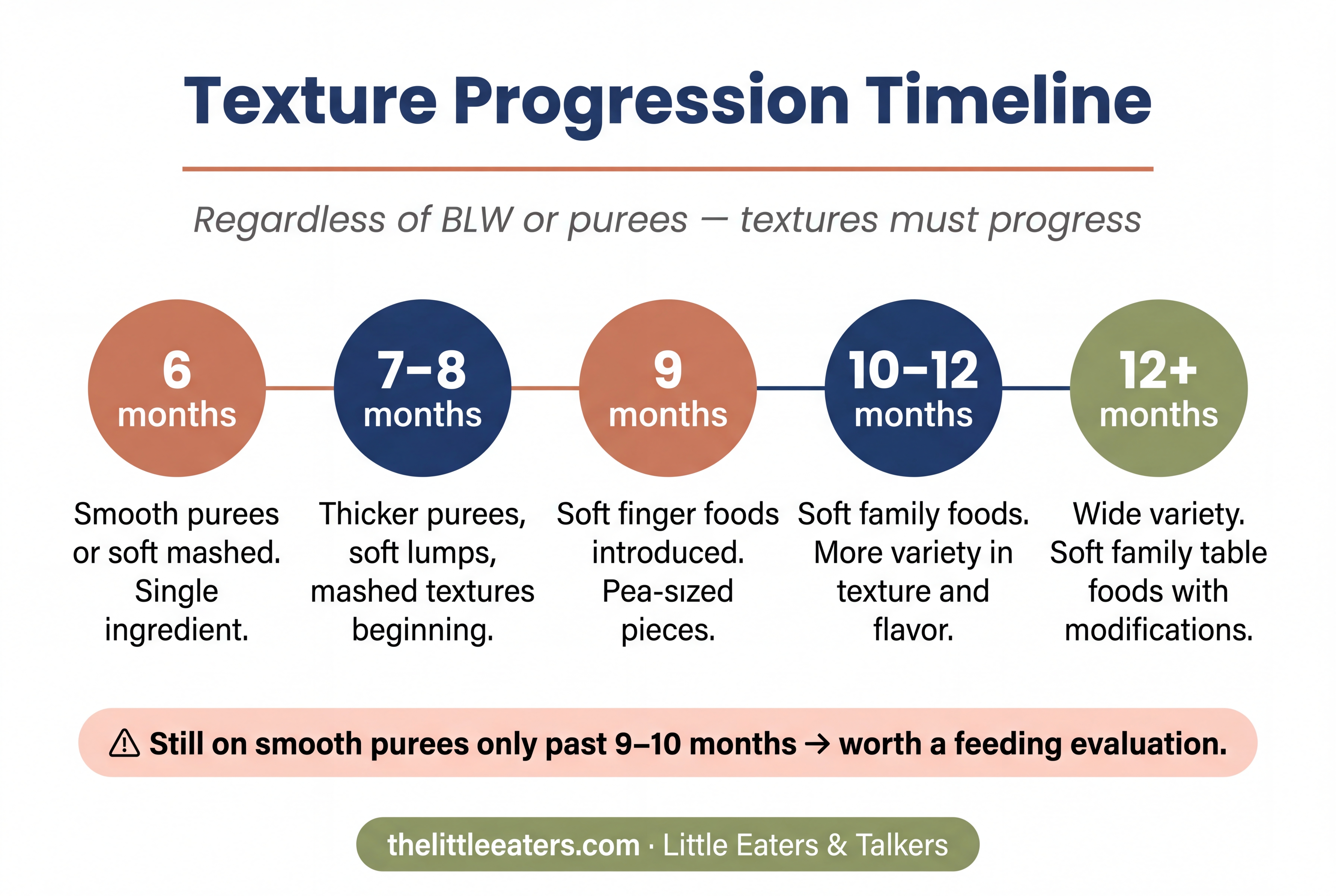
What the research does agree on: texture progression matters enormously. Babies who stay on smooth purees past 9–10 months without introduction of lumps and soft pieces show higher rates of food selectivity later. The texture needs to progress, regardless of the approach.
When Purees Are the Better Starting Point
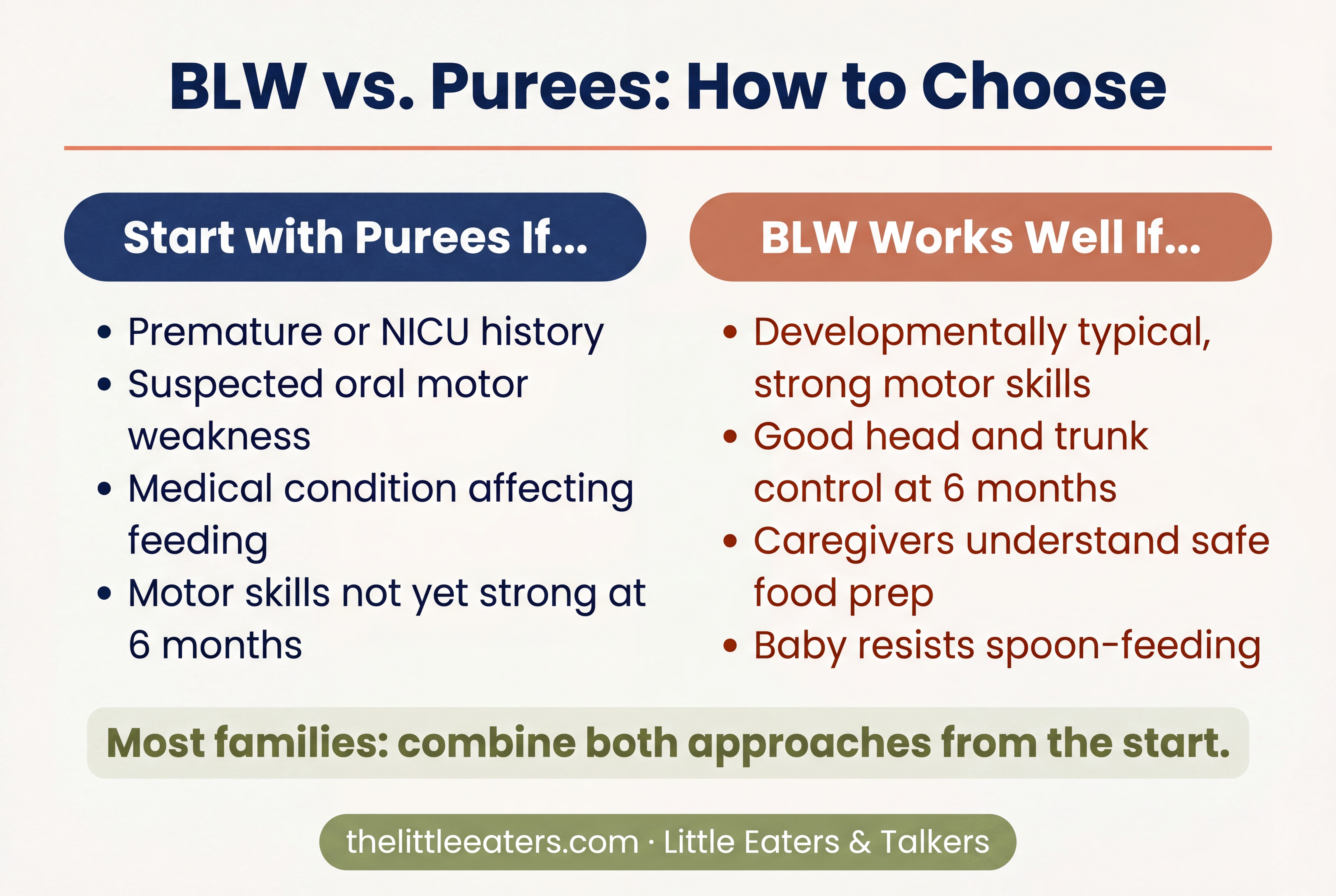
Consider starting with purees if:
Your baby was premature or has a history of NICU
Your baby has a diagnosed or suspected oral motor weakness
Your baby has a medical condition affecting feeding
Your baby has not yet shown strong self-feeding motor skills at 6 months
When BLW Is a Good Fit
BLW works beautifully for babies who:
Are developmentally typical and showing strong motor skills
Are at least 6 months with good head and trunk control
Have caregivers who understand safe food preparation
If BLW is your approach: the most important thing is food safety. BLW-appropriate foods are soft enough to be squished between thumb and finger. Round, firm foods — grapes, whole cherry tomatoes, raw carrots — remain dangerous regardless of approach.
What I Actually Recommend
The combined approach. Offer a variety of textures from the beginning — some spoon-fed, some self-fed — and advance textures progressively.
Don't stay on smooth purees past 8–9 months. Introduce soft lumps and mashed textures between 7–9 months. Introduce soft finger foods by 9 months.
Download our Starting Solids Guide for a month-by-month texture progression chart.
Frequently Asked Questions
Q: Is baby-led weaning safe for a 6-month-old?
For a developmentally typical 6-month-old with good motor skills, BLW is generally safe when foods are prepared appropriately.
Q: Will BLW really reduce picky eating later?
Some studies suggest it may support better appetite regulation. But picky eating is complex — BLW is not a guarantee against food selectivity.
Q: My baby is 9 months and still on purees. Is that a problem?
It's worth progressing textures now if you haven't already. If your baby is resisting all texture beyond smooth purees at 9+ months, a feeding evaluation is a reasonable next step.
The BLW vs. purees question matters much less than texture progression and following your baby's developmental cues.
Let's talk if starting solids isn't going smoothly.
Written by Jean Hawney, M.A., CCC-SLP | Feeding Specialist & Speech-Language Pathologist at Little Eaters & Talkers, Bellaire, TX. Jean works with infants and toddlers to make mealtimes easier for the whole family. Book a consultation →