
Can Solid Foods Help a Baby Gain Weight? What a Feeding Therapist Wants You to Know
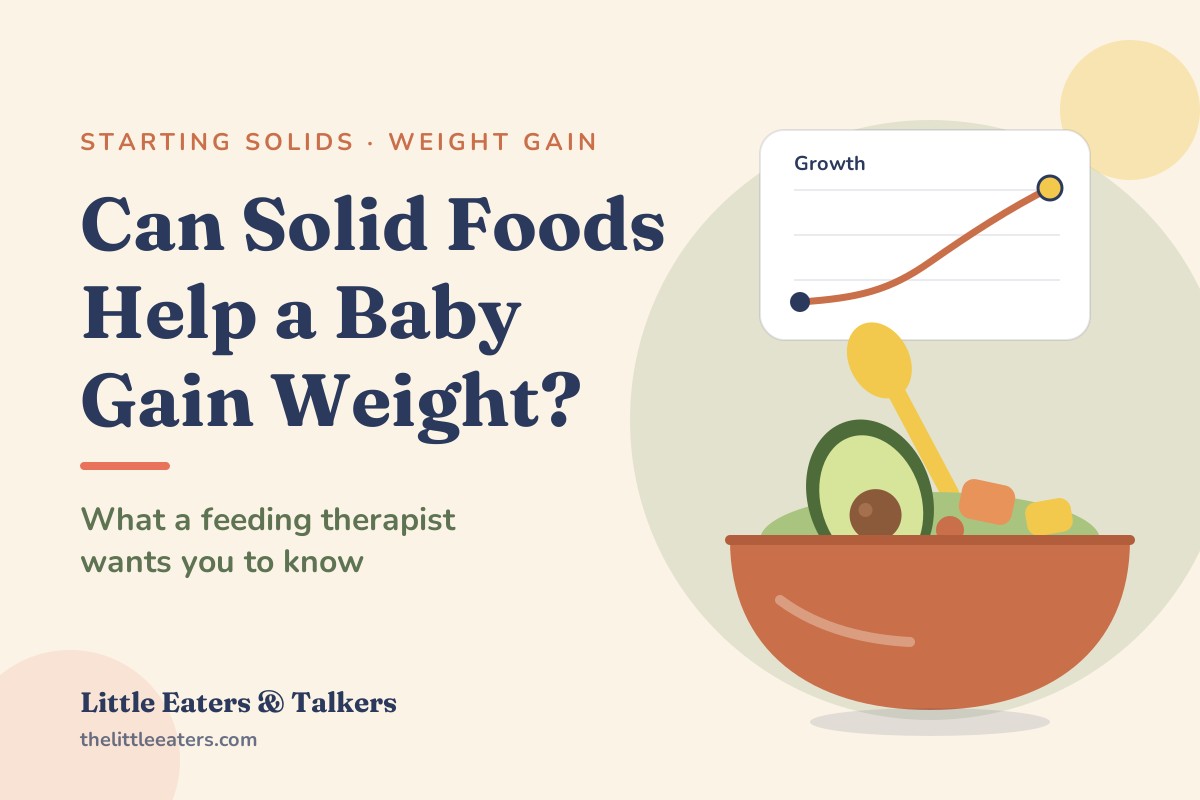
When this mom first came to see me, her 8-month-old daughter was at the 3rd percentile for weight. She was a happy, alert baby who drank her formula well and ate a few jars of baby food every day. On paper, the family was doing everything right. But the scale kept saying otherwise, and every pediatrician visit came with the same worried conversation.
We worked together for one month. At her next weigh-in, she had jumped from the 3rd percentile to the 25th. Her mom told me the pediatrician actually stopped and asked, "What are you doing differently?"
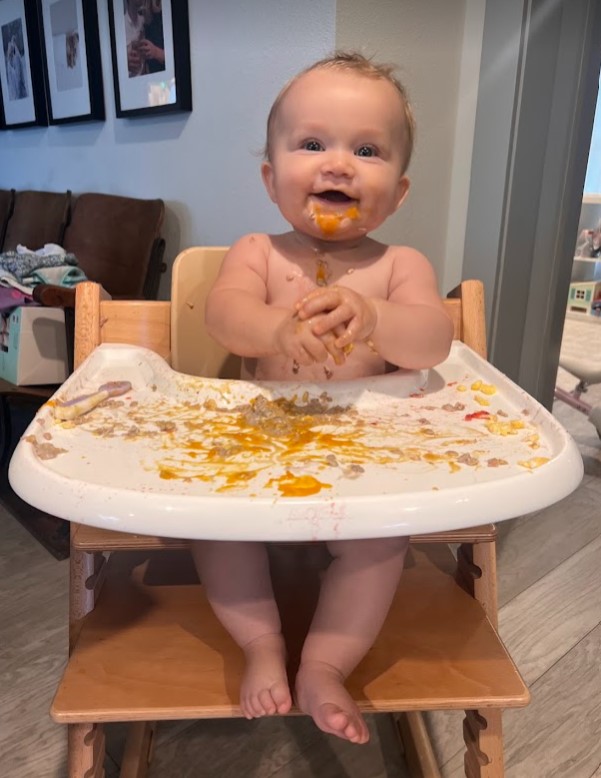
Here's the honest answer: we didn't add a special supplement or force more bottles. We changed what was on her spoon and tray, how she was eating it, and how often food showed up in her day. If you've heard that "food before one is just for fun," this story is exactly why I disagree. For some babies, food before one is the missing piece in their growth.
This post is for general education. If your baby is having trouble gaining weight, work with your pediatrician first. Weight concerns can have medical causes that need to be ruled out, and a feeding team (pediatrician, dietitian, and feeding therapist) works best together.
Table of Contents
Why Weight Gain Can Stall After 6 Months
The Problem With Relying on Jarred Baby Food
What We Changed: How Solids Helped This Baby Gain Weight
Calorie-Dense First Foods for Babies Who Need to Gain Weight
Why Texture and Self-Feeding Matter for Weight Gain
When to Get Help
FAQ
Why Weight Gain Can Stall After 6 Months
For the first six months, breastmilk or formula can cover everything a healthy baby needs. Around 6 months, that changes. Babies are growing, moving, and burning more energy, and milk alone starts to fall short. The World Health Organization notes that if solids aren't introduced around this age, or aren't the right kind, a baby's growth can falter.
Milk still matters a lot. It provides a big share of a baby's energy through the first year. But solids are meant to close the gap between what milk gives and what a growing baby needs. If the solids a baby eats don't add much energy, that gap stays open, and it can show up on the growth chart.
The Problem With Relying on Jarred Baby Food
This surprises almost every parent I tell: many jarred and pouched baby foods don't have more calories than milk.
A UK study of hundreds of ready-made spoonable baby foods found their energy content was almost the same as breastmilk. The researchers estimated that a portion of homemade family-style food could provide about the same energy and protein as twice that amount of a similar store-bought product. A 2026 study of UK pouches and jars found most still delivered less energy than breastmilk, and many pouches were higher in sugar.
So when a baby eats a jar of pureed pears, it may fill up her tummy without adding much. If that jar takes the place of a bottle, she can end up with fewer calories than before.
Jarred food isn't bad. It's convenient, safe, and has a place in plenty of families' routines. But for a baby who needs to gain weight, it usually can't be the main event.
What We Changed: How Solids Helped This Baby Gain Weight
Every baby's plan is different, but here's what we focused on with this little girl:
More energy in every bite. We swapped many of the fruit and veggie jars for homemade or family foods, and added healthy fats like olive oil, butter, avocado, and nut butters.
Protein and iron at every meal. Shredded meats, eggs, beans, full-fat yogurt, and cheese replaced plain fruit purees as the base of her meals.
Moving beyond smooth purees. We added thicker mashes, soft lumps, and easy finger foods so she could eat more efficiently and build her chewing skills.
A predictable eating schedule. Meals and snacks at regular times, with milk feeds spaced so she came to the table hungry, not too full or too exhausted.
Calm, pressure-free meals. No chasing her with the spoon, no distraction tricks. Babies who feel safe at the table often eat more, not less.
None of these changes are dramatic on their own. Together, they made each meal count.
Calorie-Dense First Foods for Babies Who Need to Gain Weight
The American Academy of Pediatrics suggests that for babies eating solids, calorie-dense additions like oil, avocado, cream, butter, and peanut butter can be used to boost the energy in foods. Here are some easy ways to do that at home:
Stir a teaspoon of olive oil or butter into purees, mashed veggies, or oatmeal.
Serve avocado mashed, in spears, or mixed into other foods.
Thin smooth peanut or almond butter into oatmeal or yogurt (a great allergen exposure too).
Choose full-fat plain yogurt and cheese instead of low-fat versions.
Mix infant cereal with formula or breastmilk instead of water.
Offer eggs, shredded dark-meat chicken, salmon, and slow-cooked beef.
Mash beans or lentils with a little oil and seasoning.
The goal isn't to load every food with butter. It's to make sure the foods your baby does eat are working hard. The AAP also recommends regular follow-up so weight gain stays on track and doesn't overshoot. That's one more reason to do this with your pediatrician and a dietitian, not on your own.
Want more support? Check out our free course, Helping Your Baby Learn to Eat Solids, and our free handouts: Starting Solids, Food Allergens, and Feeding Checklist. We also share our favorite products for starting solids on our Linktree.
Why Texture and Self-Feeding Matter for Weight Gain
This is the feeding therapy side of the story, and it's often what gets missed.
A baby who can only manage thin, smooth purees is limited in what she can eat and how much of it she can take in. Thin purees are mostly water. Thicker textures and soft finger foods pack more nutrition into each bite, and they let babies feed themselves, which many babies enjoy and stick with longer.
The WHO notes that most babies can eat finger foods by about 8 months. If your baby is still only on smooth purees at that age, it's worth looking at why. Sometimes it's just habit. Sometimes there's an oral motor or sensory piece that a feeding therapist can help with. Either way, building those skills can open up a lot more food.
For more on why textures matter, read Food Before One Is NOT Just for Fun.
When to Get Help
Talk to your pediatrician, and consider a feeding evaluation, if your baby:
Is dropping percentiles, or staying very low on the growth chart
Takes a long time to eat (more than 30 minutes) or tires out during meals
Coughs, gags, or vomits often during meals
Refuses most solids, or only accepts smooth purees after 8 to 9 months
Seems uninterested in food or upset at most meals
You know your baby best. If something feels off, trust that feeling and ask.
FAQ
Can solid foods really help my baby gain weight? Yes, for many babies. After about 6 months, milk alone often doesn't cover a baby's energy needs. Calorie-dense solids help close that gap. But weight concerns should always be checked by your pediatrician first.
Is jarred baby food enough for a baby who needs to gain weight? Often not on its own. Studies have found many ready-made baby foods have about the same energy as breastmilk. Adding fats and protein, or offering family foods, usually provides more.
What are the best foods to help a baby gain weight? Foods with healthy fats and protein: avocado, nut butters, full-fat yogurt, cheese, eggs, meats, fish, and beans. Adding a little oil or butter to purees and veggies is an easy boost.
Should I give my baby more formula instead of solids? Milk is still important through the first year. But more milk isn't always the answer after 6 months, and it can crowd out solids. Talk with your pediatrician or dietitian about the right balance for your baby.
How fast should I see results? Every baby is different, and some need more time or a medical workup. With the right plan, many families see progress at the next few weigh-ins.
Closing
That pediatrician asked what this mom was doing differently, and the answer was simple: she stopped treating solids as an extra and started treating them as part of her daughter's nutrition. Food before one can absolutely be fun. For a baby who's struggling to grow, it can also be the thing that changes the growth chart.
If your baby is having trouble gaining weight or struggling with solids, you don't have to figure it out alone. Book a consultation and we'll build a plan that fits your family.
Written by Jean Hawney, M.A. CCC-SLP — Feeding Specialist at Little Eaters & Talkers in Houston, TX. Jean works with infants and toddlers to make mealtimes easier for the whole family. Book a consultation →
Sources
World Health Organization. Complementary feeding. https://who.int/nutrition/topics/complementary_feeding/en/
Garcia AL, Raza S, Parrett A, Wright CM. Nutritional content of infant commercial weaning foods in the UK. Arch Dis Child. 2013. (Summary: https://sciencedaily.com/releases/2013/09/130909201325.htm)
Garcia AL, et al. Texture and nutrient content of commercial baby foods supplied in spouted pouches, compared to other packaging. Arch Dis Child. 2026. doi:10.1136/archdischild-2026-330535
American Academy of Pediatrics. Clinical Practice Guideline for Faltering Weight: Dietary Guidance. https://www.aap.org/en/patient-care/clinical-practice-guidelines-for-diagnosis-and-management-of-faltering-weight/dietary-guidance/