
What Nobody Tells You Before Your First Feeding Therapy Session
You have read the articles. You have followed the accounts. Somewhere in the back of your mind, a quiet voice keeps saying maybe we should see someone. And then it stops you, because you have no idea what feeding therapy actually is, and the unknown is scary.
So here is exactly what to expect, start to finish. Feeding therapy is almost certainly not what you are picturing. There are no forced bites. There is no crying child being made to clean a plate. Let us take the mystery out of it.
What Feeding Therapy Is Not
Let us clear the scariest picture first. Good feeding therapy does not force, bribe, or pressure a child to eat.
No holding a spoon to a clamped mouth. No making a child sit until the plate is empty. No rewards charts that turn eating into a performance. Those tactics get short-term compliance and long-term fear, which is the opposite of the goal. Real feeding therapy is built on making food feel safe, and safety and force cannot exist in the same room.
What Actually Happens
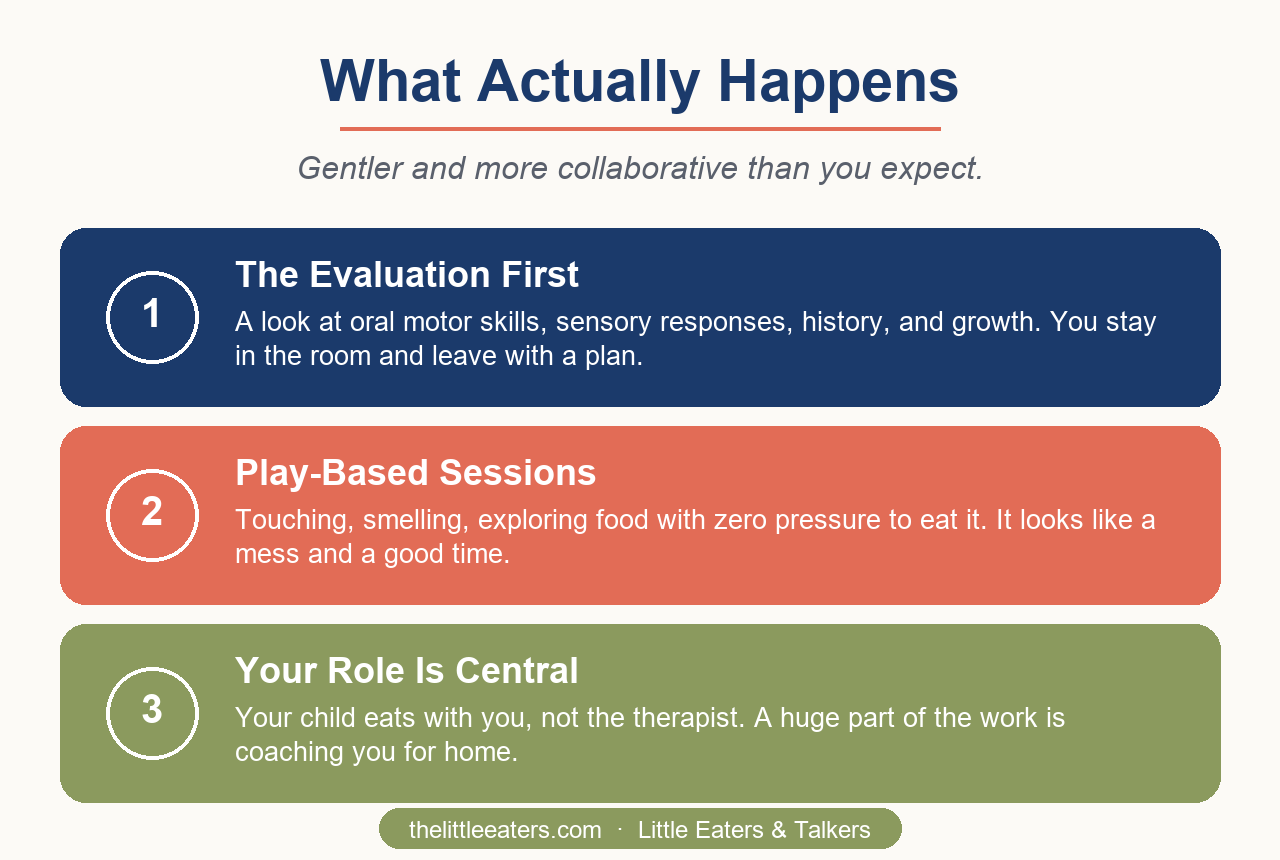
From the first evaluation onward, the process is gentler and more collaborative than most parents expect.
The Evaluation Comes First
Your first visit is an evaluation, not a treatment blitz. The therapist looks at your child's oral motor skills, sensory responses, feeding history, growth, and how mealtimes actually go at home. You stay in the room the whole time. You leave knowing whether this is a phase or something that needs support, and what the plan is either way.
Sessions Are Play-Based
For young children, therapy looks like play, because that is how their nervous systems learn. Touching, squishing, smelling, and exploring foods with zero pressure to eat them. It can look like a mess and a good time, and underneath, the therapist is building the exact skills and safety your child needs.
Your Role Is Central
You are not a spectator. Your child eats with you far more than with any therapist, so a huge part of the work is coaching you on what to do at home. Parents are the engine of progress, which is good news, because it means the change comes home with you.
How Long It Takes
This is the honest part. Feeding progress is rarely fast, and it is almost never a straight line.
You are not looking for a child who suddenly eats broccoli next week. You are looking for a child who is calmer at the table, willing to be near new foods, and gradually accepting more over weeks and months. Some children move quickly, others slowly, and a good therapist will give you a realistic picture rather than a promise. Steady beats dramatic every time.
The Logistics Nobody Explains
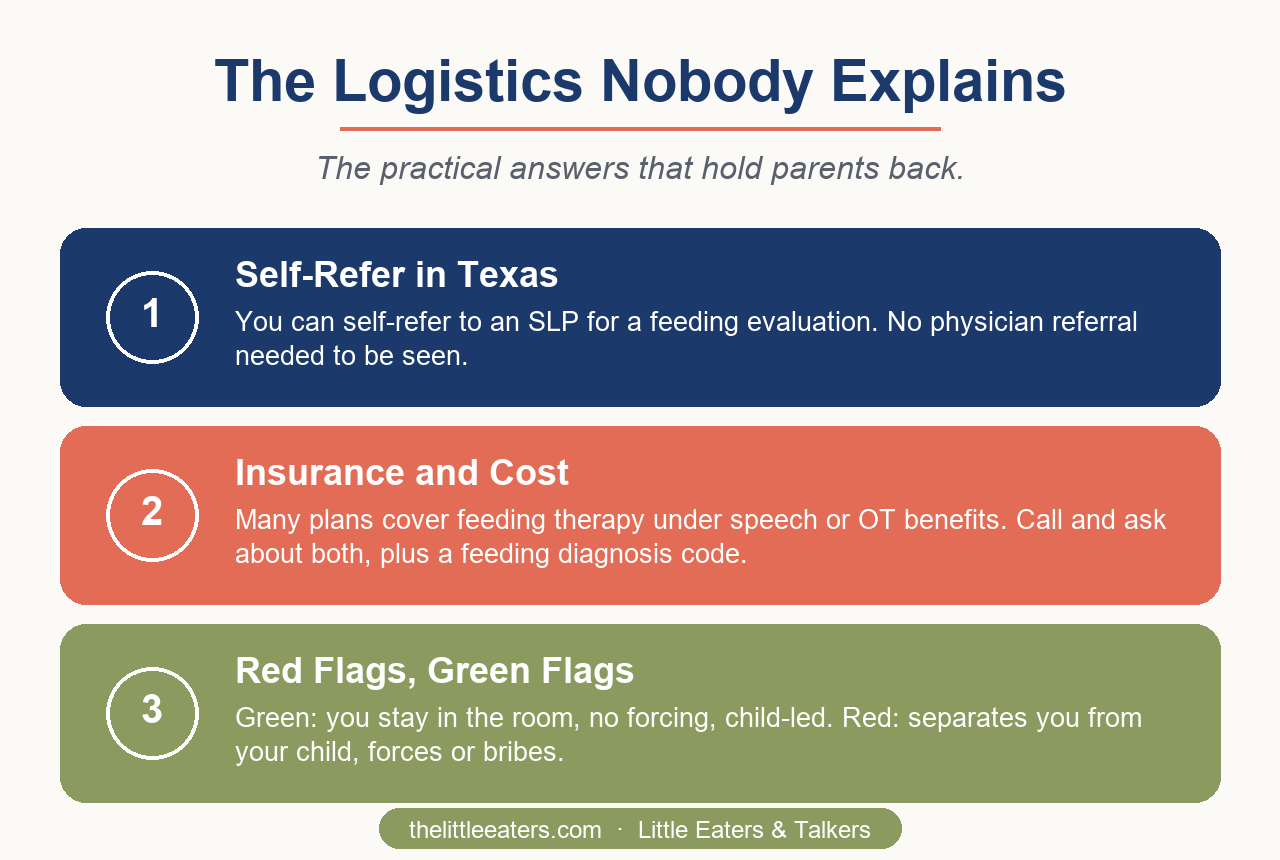
The practical questions are often what hold parents back the longest, so here are the plain answers.
You Can Self-Refer in Texas
In Texas you can self-refer to a speech-language pathologist for a feeding evaluation. You do not need to wait for a physician's referral to be seen, so if your gut says it is time, you can reach out directly.
Insurance and Cost
Many plans cover feeding therapy under speech or occupational therapy benefits, often with a feeding diagnosis code. Coverage varies, so it is worth calling your plan and asking about both speech and OT benefits. A referral can help with the paperwork even where it is not required to be seen.
Red Flags and Green Flags
A good feeding therapist keeps you in the room, never forces bites, uses pressure-free and child-led approaches, and talks openly about your child's specific plan. Be cautious of anyone who separates you from your child, relies on forcing or bribing, or cannot explain their approach in plain language. Trust your read of whether your child feels safe.
Frequently Asked Questions
How do I know if my child even needs feeding therapy?
If your child eats very few foods, is losing foods, melts down at most meals, gags or vomits often, or is falling off their growth curve, an evaluation is reasonable. The evaluation itself will tell you whether therapy is needed, so you are not committing to anything by simply finding out.
Will my child be forced to eat foods they hate?
No. Good feeding therapy never forces. The entire approach is built on lowering pressure and building safety, because force makes feeding difficulties worse, not better.
Do I stay in the room?
Yes, and you should. Parent involvement is one of the strongest predictors of progress, and any provider who wants to separate you from your young child is worth questioning.
What should I bring to the first appointment?
A few days of notes on what your child eats and refuses, any gagging or distress, and how mealtimes go, plus a list of your questions. Concrete details help the therapist see the real picture quickly.
The Only Thing to Fear Is Waiting
If a quiet voice has been telling you to look into this, that instinct is worth trusting. The evaluation costs you an hour and gives you an answer, and for most families the relief of finally understanding what is going on is enormous.
Our team works with infants and toddlers across Houston and Bellaire, and the first step is always the same: a calm, honest evaluation that tells you where your child stands and what, if anything, would help.
Book a consultation with us and we will walk you through exactly what to expect.
For more free guidance, visit thelittleeaters.com/FreeDownloads.
Written by The Little Eaters & Talkers Team, a group of pediatric feeding and speech specialists based in Bellaire, TX. We help infants and toddlers navigate feeding challenges, sensory food aversions, and speech development so mealtimes can feel easier for the whole family.