

Food Chaining: How to Grow a 5-Food Kid to 20 Foods
They ate five foods. Chicken nuggets, one specific brand. Goldfish. Plain pasta. Yogurt tubes. Toast. Every meal was a version of those five, and every attempt at a sixth ended in refusal or tears.
A year later, that same child ate more than twenty foods. Nobody forced a single bite. The tool that got them there has a name, and most parents have never heard of it. It is called food chaining.
What Food Chaining Actually Is
Food chaining is the practice of building small bridges from the foods a child already accepts to new ones that are just slightly different.
Instead of asking a child to leap from a chicken nugget to a piece of broccoli, you take tiny, low-risk steps along a chain of similar foods. Each new food shares something with the last one, so it never feels completely foreign. The child's nervous system stays inside its zone of safe, and the diet widens one small link at a time.
How Food Chaining Works
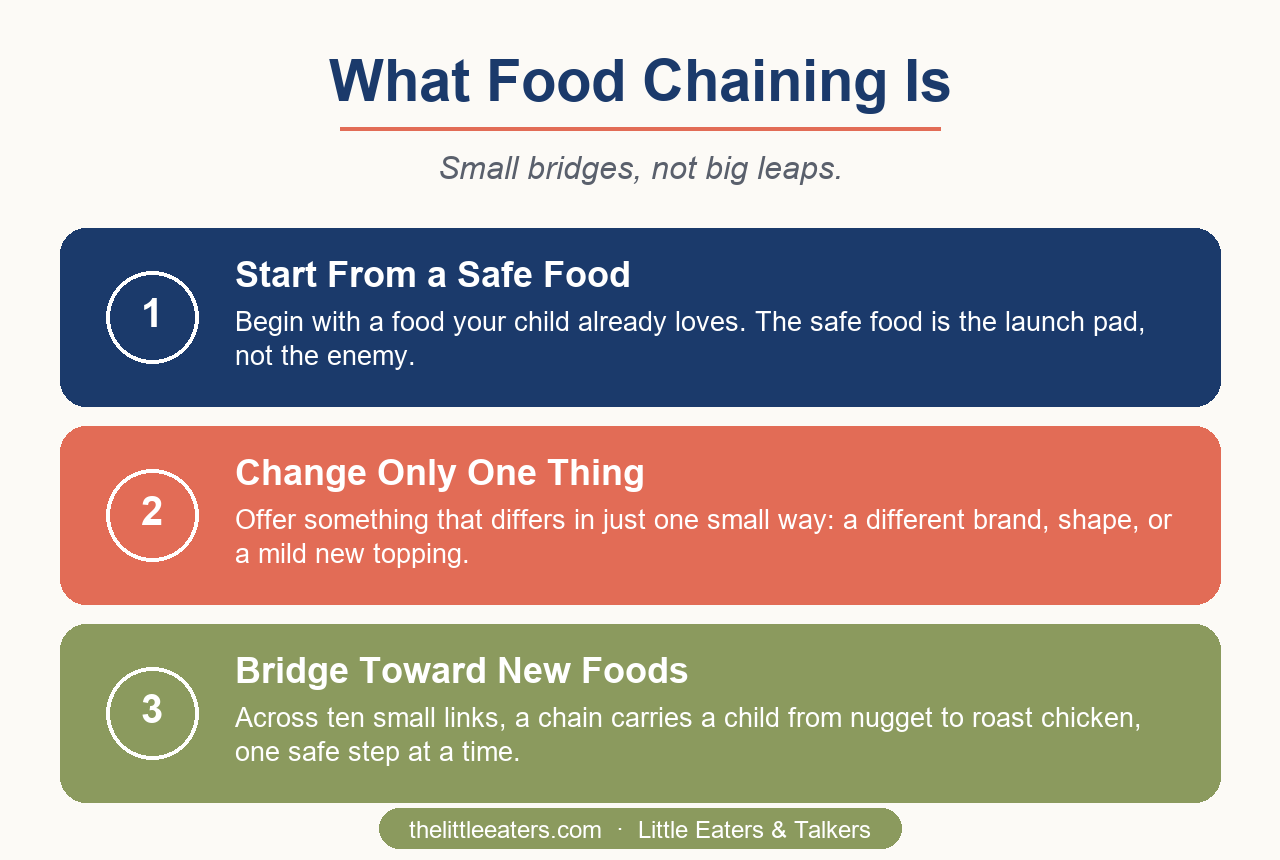
Every chain starts with what your child already eats and moves outward by changing one feature at a time.
Start From a Safe Food
Begin with a food your child reliably accepts and genuinely likes. This is the anchor, and it is the opposite of where most parents start, which is with the food they most want their child to eat. The safe food is the launch pad, not the enemy.
Change Only One Thing
From that anchor, offer something that differs in just one small way. If your child loves one brand of chicken nugget, a similar nugget of a different brand or shape is a genuine step. A homemade breaded chicken strip might be the next link. Each change is small enough to feel safe.
Bridge Toward New Foods
Over many small links, a chain can carry a child a surprisingly long way. A crunchy cracker can bridge to a cracker with a mild topping, then to a different crunchy food entirely. The distance between nugget and roast chicken feels impossible in one jump and very possible across ten small ones.
How to Start Food Chaining at Home
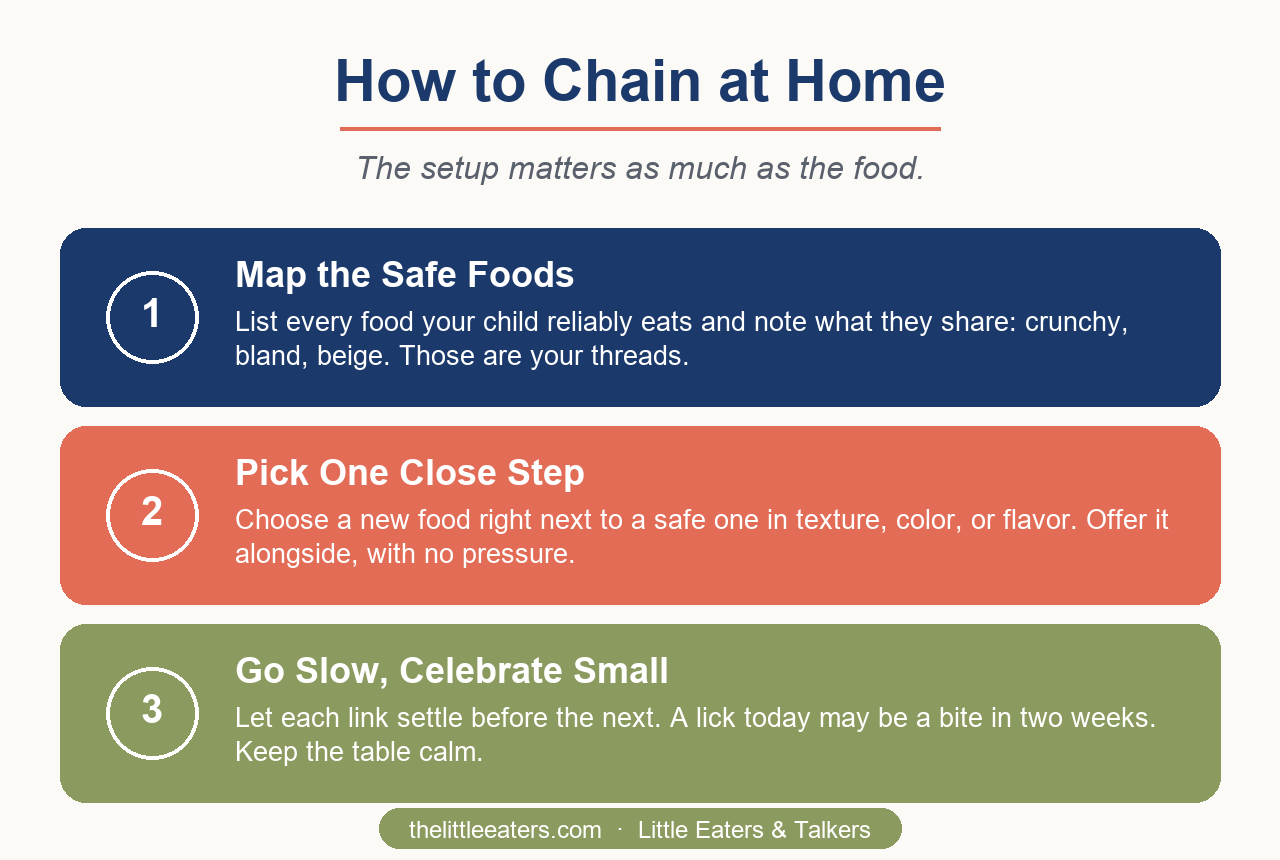
You can begin gently at home, and the setup matters as much as the food.
Map Your Child's Safe Foods
Write down every food your child reliably eats, and note what they have in common. Are they mostly crunchy? Mostly bland? Mostly beige and dry? Those shared features are the threads you will follow to new foods.
Pick One Small, Close Step
Choose a single new food that sits right next to an existing safe food, sharing texture, color, or flavor. Offer it alongside the safe food, with no pressure to eat it. Being near it and touching it are real steps, not failures.
Go Slow and Celebrate Small
Let each link settle before adding the next. A child who licks a new food today may bite it in two weeks. Keep your reaction calm and light either way, because a neutral table is what keeps the chain moving.
Common Mistakes Parents Make
Food chaining is simple in principle and easy to rush in practice. These are the traps we see most.
Changing too much at once is the big one. A new food that differs in texture and color and temperature is not a link, it is a leap, and it usually gets refused. Keep each step boringly small.
Moving too fast is the next. Progress in feeding is measured in weeks and months, not meals. Pushing for the next link before the last one feels safe undoes the trust you are building.
And attaching pressure to the chain quietly breaks it. The moment a child senses that the new food comes with an expectation, the safety that makes chaining work disappears. Offer, do not push.
Frequently Asked Questions
How long does food chaining take?
It varies widely by child. Some links form in days, others take weeks. The pace is set by the child's comfort, not by a schedule, and slow, steady progress is exactly what you are aiming for.
Can I do food chaining myself, or do I need a therapist?
Many parents make real progress at home with gentle chaining. If your child has a very small number of foods, is losing foods, or the chain keeps stalling no matter how small the steps, a feeding therapist can map the chain for you and find the links you cannot see.
What if my child refuses the very next link?
Then the link was too big. Step back to something even closer to a safe food and shrink the change. A refusal is information, not failure, and it usually means the jump needs to be smaller.
Does food chaining work for sensory food aversions?
Yes, and it is often the right tool for them, because it respects the child's need for predictability while gently widening the range. For strong sensory aversions, pairing chaining with sensory support tends to work best.
Five Foods Is a Starting Point, Not a Life Sentence
If your child's list feels frighteningly short, that number is not fixed. Diets grow, one small link at a time, when the steps are small enough and the pressure is gone.
Our team works with families across Houston and Bellaire on exactly this, turning a tiny list of safe foods into a wider one without the battles. We can map your child's chain and show you the next small step.
Book a consultation with us and we will help you build the first bridge.
For more free guidance, visit thelittleeaters.com/FreeDownloads.
Written by The Little Eaters & Talkers Team, a group of pediatric feeding and speech specialists based in Bellaire, TX. We help infants and toddlers navigate feeding challenges, sensory food aversions, and speech development so mealtimes can feel easier for the whole family.