
Is My Baby Ready for Solids? What to Look For at 4, 5, and 6 Months
You've heard "wait until 6 months." Your baby is 5 months old and lunging for your fork. Your pediatrician said 4 months is fine. The internet says something different every time you search.
Here's the truth: the calendar matters less than the child in front of you.
Readiness for solids isn't about hitting a specific date. It's about a set of developmental skills your baby either has or doesn't — and those skills can appear anywhere from 4 to 7 months depending on the child.
Why the Timing Conversation Is Complicated
Current guidelines recommend starting solids around 6 months, not before 4 months, and based on developmental readiness — not a specific date.
That range — 4 to 6 months — exists because babies develop at different rates. A 5.5-month-old who shows all the readiness signs is probably ready. A 6-month-old who doesn't show them yet probably isn't.
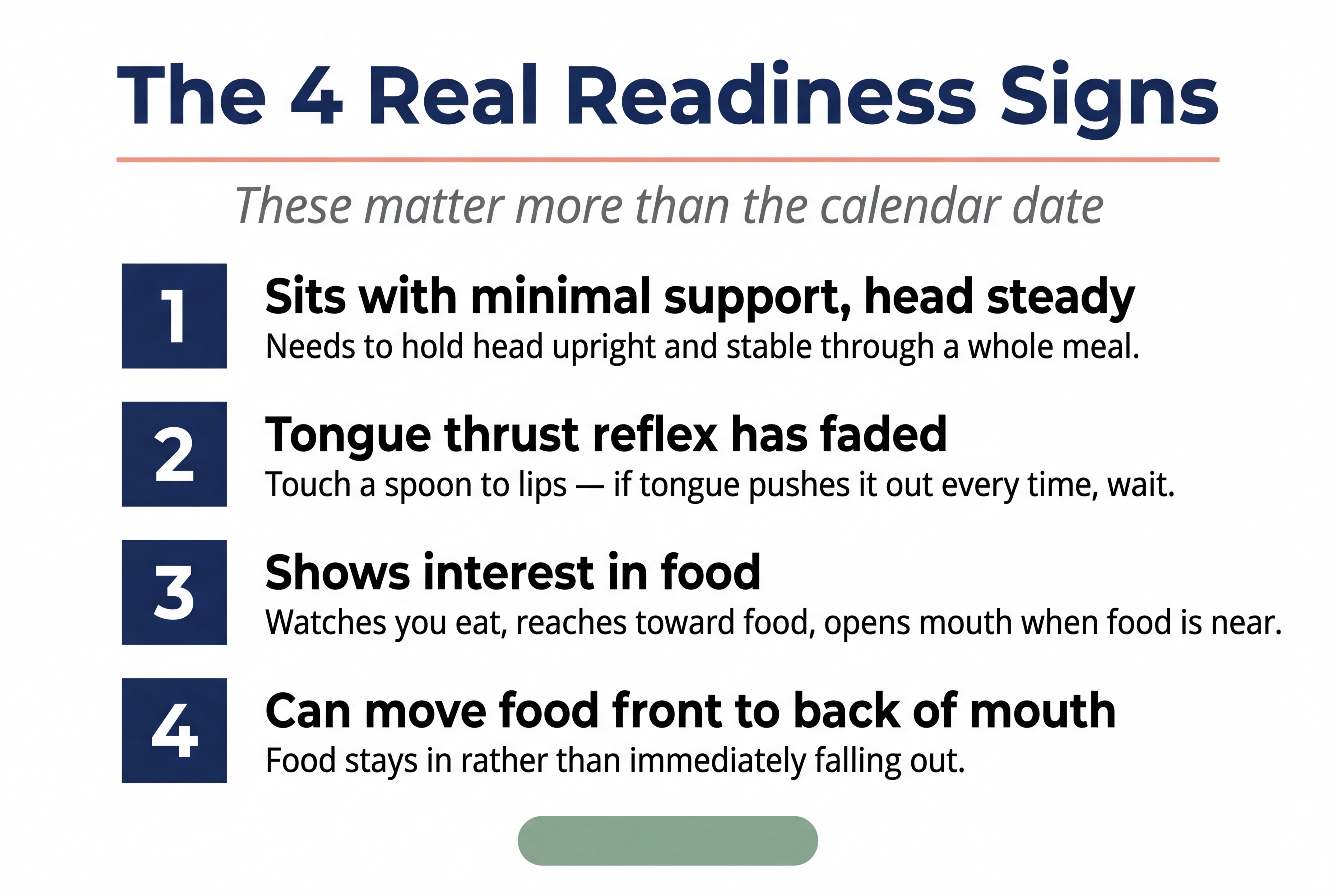
1. Sitting with minimal support and holding their head steady.
Your baby needs to be able to sit upright (supported is fine) and keep their head stable throughout a meal.
2. The tongue thrust reflex has faded.
Touch a spoon to your baby's lips. If their tongue automatically pushes it out every time, the tongue thrust reflex is still active — a protective reflex that prevents young babies from swallowing non-milk substances.
3. They show interest in food.
Watching you eat, reaching for food, opening their mouth when food comes near.
4. They can move food from the front to the back of their mouth.
You'll see this as your baby starts solids — food stays in their mouth rather than immediately falling out.
At 4 Months: What You're Watching For
At 4 months, most babies are not yet ready — and starting solids at this age carries real risks. The digestive system is still maturing and the oral motor skills for managing solid food aren't typically in place yet.
If your pediatrician is suggesting 4 months, it's worth asking which readiness signs they're seeing. The signs matter more than the date on the calendar.
At 5 Months: Watch Closely
Some babies are genuinely ready at 5 months. More often, they're almost ready — showing 2 out of 4 signs but not all of them. Check for the tongue thrust reflex regularly. There's no harm in waiting a few more weeks.
At 6 Months: Most Babies Are Ready
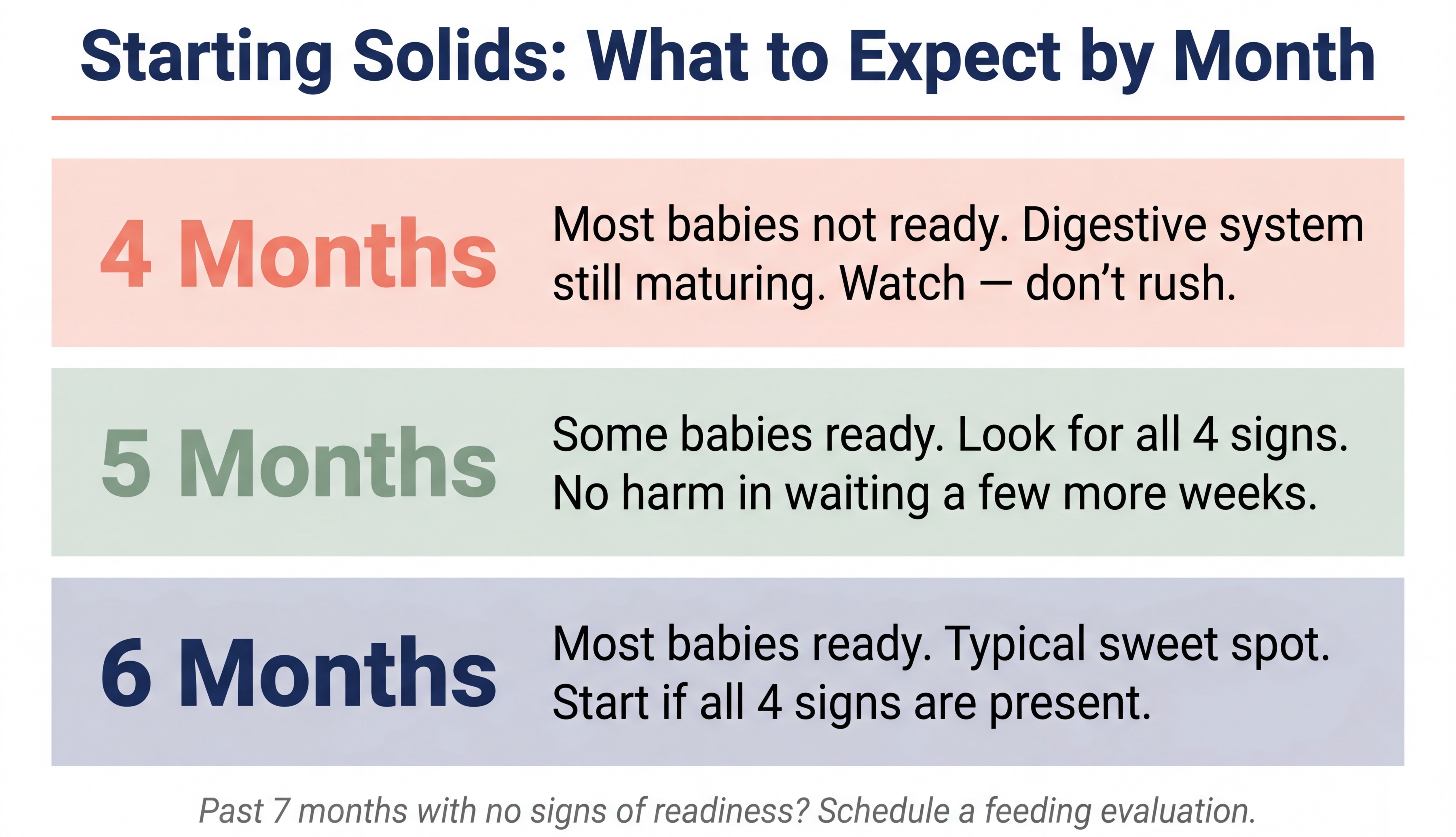
By 6 months, most babies show all four readiness signs. This is the typical sweet spot.
If your 6-month-old still doesn't seem ready — give it a little more time. But if you're past 7 months and not seeing readiness signs, a feeding evaluation is worth scheduling.
How to Start When They're Ready
Start with single-ingredient purées or soft mashed foods. One new food every 3–5 days, especially if allergy history is in your family.
For allergen introduction — peanuts, eggs, dairy, wheat, tree nuts, sesame, fish, shellfish, soy — early introduction is now supported by research for most babies.
Download ourStarting Solids Guidefor a step-by-step first foods plan. Or commentREADYbelow and I'll send it straight to your DMs.
FAQ
Q: My baby is 5.5 months and showing all readiness signs. Should I wait until 6 months?
If all four readiness signs are present, starting at 5.5 months is generally considered safe. Trust the signs over the calendar.
Q: My 6-month-old refuses the spoon. Does that mean they're not ready?
Not necessarily. Try placing a small amount of food on the tray for them to touch and explore. Baby-led weaning approaches can also work well for babies who resist being spoon-fed.
Q: Do I have to start with purees or can I do baby-led weaning?
Both approaches are supported, and many families combine them. The key is that food is age-appropriate in texture and the baby has the motor skills to manage it safely.
Q: When should I worry that my baby isn't taking to solids?
If after 4–6 weeks of consistent offering your baby is not making any progress with solids, a feeding evaluation is a good next step.
You know your baby. If something feels off — or if starting solids feels overwhelming — that's what we're here for.
Book a starting solids evaluation →or call(832)304-3506.
Written by Jean Hawney, M.A., CCC-SLP | Little Eaters & Talkers, Bellaire TX |[email protected]