
How Mealtime Pressure Makes Picky Eating Worse — And What to Do Instead
You've tried everything. "One more bite." "If you eat your broccoli you can have dessert." "Just try it — you might like it." Turning it into an airplane. Hiding vegetables. Crying in the kitchen after everyone else went to bed.
Nothing is working. And if anything, mealtimes are getting harder.
There's a reason. And it's not you — it's how pressure interacts with a child's nervous system.
Why We Default to Pressure
It makes sense. Your child isn't eating enough variety. You're worried about their nutrition. Every parent instinct says: don't let them leave the table without eating something real.
The problem is that children with feeding challenges aren't refusing food out of preference or defiance. They're refusing because eating certain foods activates a genuine stress response. And when we add more pressure on top of that stress? We make the stress response stronger.
What Pressure Does to a Child's Nervous System
When a child sits down at a table and anticipates that they're going to be asked to eat something uncomfortable, their nervous system starts preparing for a threat — before the food even appears.
Heart rate increases. Cortisol rises. The prefrontal cortex — the part of the brain responsible for being open to new experiences — goes offline.
In protection mode, a child cannot be curious about a new food. Their only job, neurologically, is to get safe.
This is why "just try it" doesn't work. You're asking a child in fight-or-flight to do something that requires calm and curiosity.
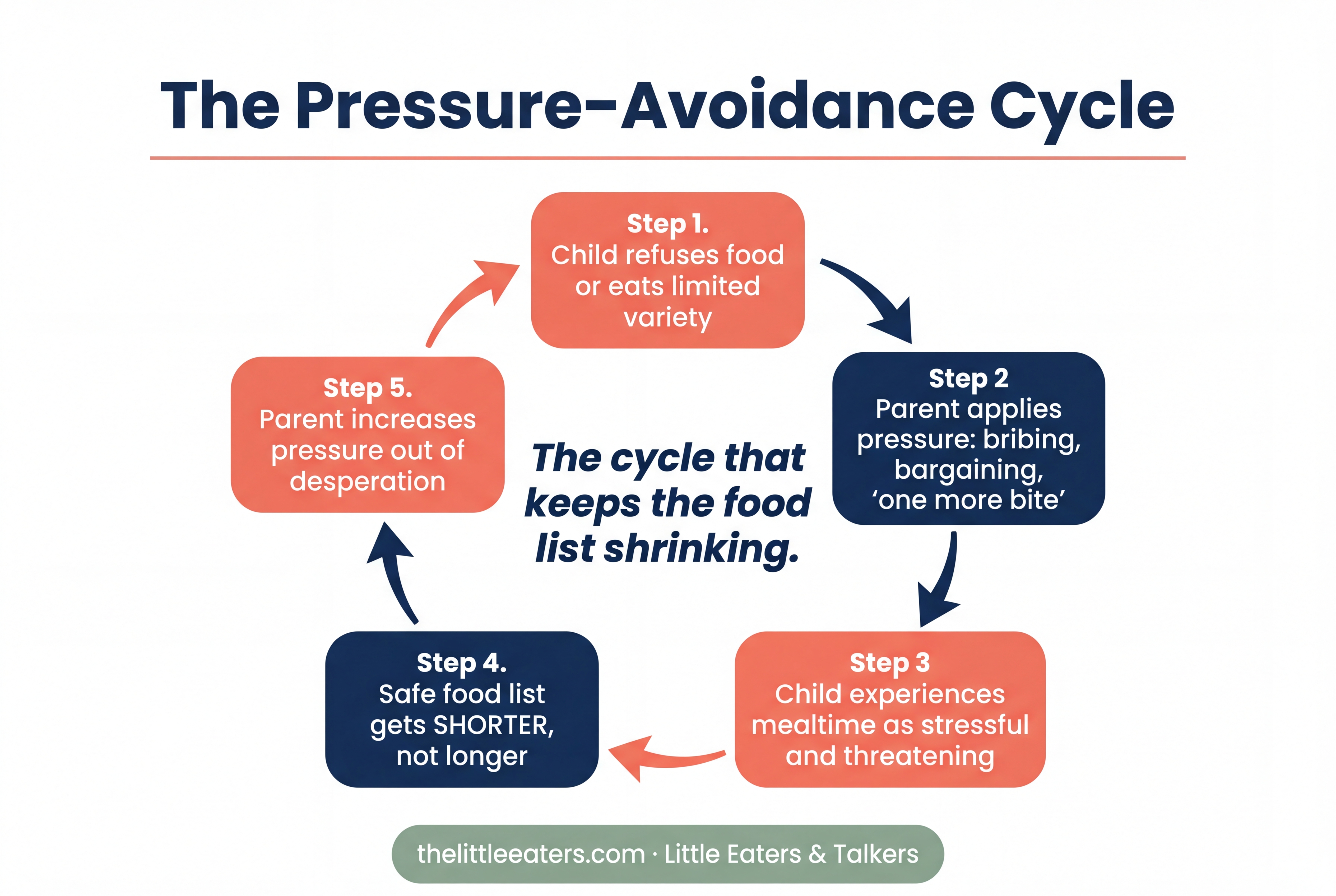
The Pressure–Avoidance Cycle
Child refuses food or eats a limited variety
Parent applies pressure (bribing, bargaining, insisting)
Child experiences mealtime as stressful
Child's safe food list gets smaller (not bigger)
Parent increases pressure out of desperation
Cycle continues
The pressure is making the food list shorter. I know that's not the intention. But the nervous system doesn't care about intention — it cares about safety.
What "Division of Responsibility" Actually Means
The most evidence-supported framework for picky eating is Ellyn Satter's Division of Responsibility:
Parents decide: what food is offered, when it's offered, where meals happen
Children decide: whether they eat and how much
In practice: you put a variety of foods on the table including at least one accepted food. You eat your own meal and model eating without commentary. Zero comment about what your child eats or doesn't eat. No bribes. No substitutes for rejected foods. No short-order cooking.
This removes the pressure from the child's experience of eating. When there is no pressure, the nervous system can relax. When it relaxes, curiosity is possible.
What to Do Instead of Pressure
Repeated neutral exposure. Put a small amount of a new food on the table — not on their plate — without comment. Over 15–20 exposures (over weeks), many children will begin to show interest.
Eat together. Children learn from watching adults eat. Model eating the food with genuine enjoyment.
Take pressure off completely. For at least 4–6 weeks. No bribing, no negotiating, no "just one bite."
Keep accepted foods on the table. Your child should always have something they can eat at every meal.
Get support if the list is short. Browse our free feeding resources as a starting point.
Frequently Asked Questions
Q: If I stop pressuring my child, won't they just eat nothing?
In the short term, possibly. Children who have been in a pressure dynamic often test the new boundaries before relaxing into them. Over weeks, most children stabilize — especially when accepted foods are always available.
Q: Is it okay to use dessert as an incentive to eat vegetables?
Research consistently shows it increases the child's dislike of the dinner food and increases their desire for the dessert. Dessert works better served alongside dinner or without conditions.
Q: My child has been eating the same 5 foods for a year. Is this now a deeper issue?
A food list that has been stuck or shrinking for more than 3–6 months usually warrants a feeding evaluation. Pressure-free strategies are important, but they may not be sufficient on their own if there are sensory or oral motor factors.
You don't have to fight every meal. Book a consult →
Written by Jean Hawney, M.A., CCC-SLP | Feeding Specialist & Speech-Language Pathologist at Little Eaters & Talkers, Bellaire, TX. Jean works with infants and toddlers to make mealtimes easier for the whole family. Book a consultation →