
What Is Occupational Therapy for Kids (And Could It Help Your Child Eat)?
Your pediatrician wrote you a referral for occupational therapy. You nodded, took the paper, and walked out with no real idea what it meant. Occupational therapy? Your two-year-old does not have a job.
You are not missing something obvious. The name is genuinely confusing, and almost nobody explains it in plain language. So here is what pediatric occupational therapy actually is, who it helps, and why a feeding specialist like our team works alongside OTs so often.
What "Occupational" Means for a Child
For a child, their occupation is not a job. It is the daily work of being a kid: eating, playing, dressing, tolerating textures, holding a crayon, sitting still enough to learn.
Occupational therapy helps a child do those everyday tasks when something is getting in the way. For a lot of the families we see, the thing getting in the way is sensory, and it shows up most clearly at the table.
What Pediatric OT Actually Helps With
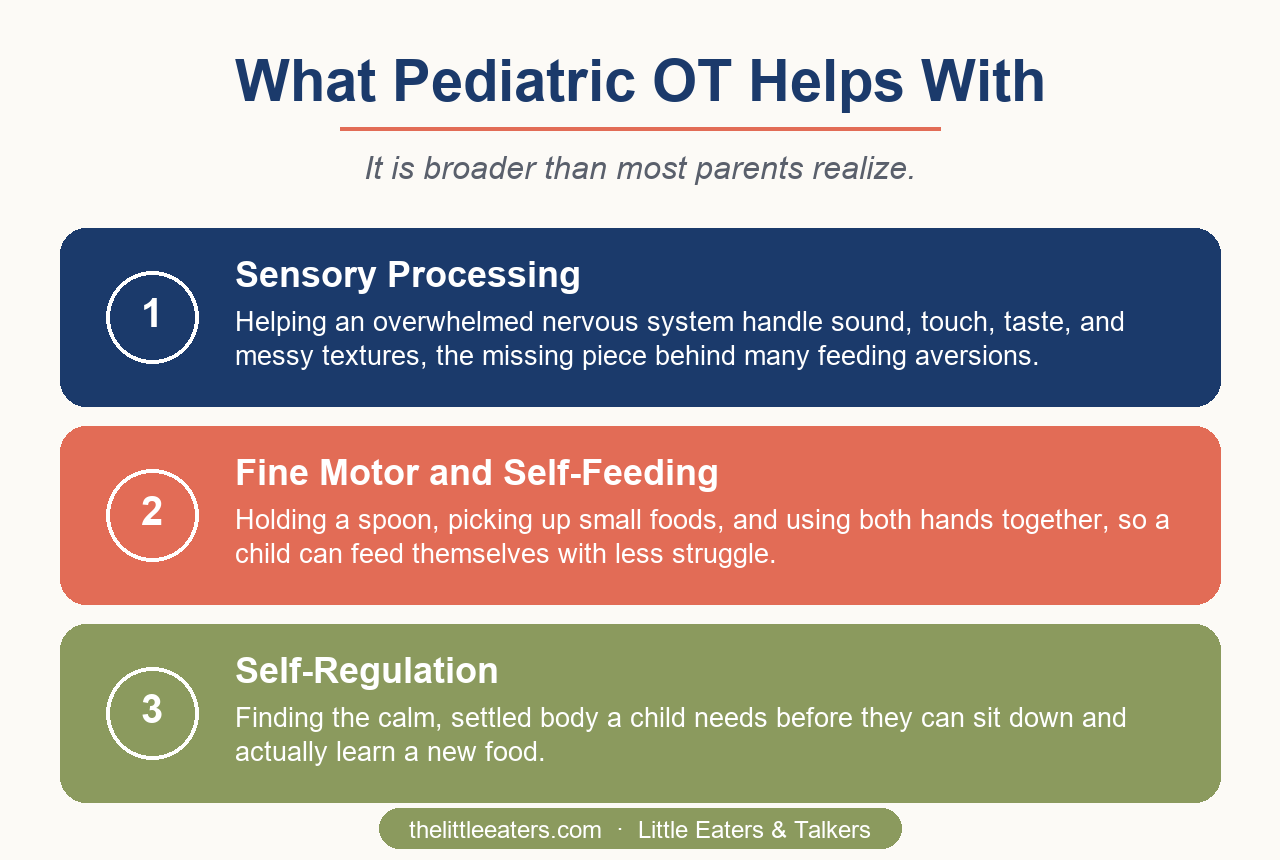
OT is broad, which is part of why it gets misunderstood. These are the three areas that matter most for the toddlers and young children we work with.
Sensory Processing
Some children take in sound, touch, taste, and movement more intensely than others, and their nervous system can become overwhelmed by things that seem small to us. A tag, a loud room, a wet or lumpy food, or messy hands can feel genuinely intolerable. An OT helps a child's system learn to handle that input without shutting down, which is often the missing piece behind sensory feeding aversions.
Fine Motor and Self-Feeding
Holding a spoon, picking up a small piece of food, managing a cup, using both hands together. These are fine motor skills, and they are harder than they look. When they lag, self-feeding stalls and mealtimes get frustrating for everyone. OT builds these skills through play so a child can feed themselves with less struggle.
Self-Regulation
A child has to be calm and organized enough in their body to sit at a table and eat. A child who is dysregulated, either wound up or checked out, cannot learn a new food in that state. OT helps children find and hold that calm, settled place, which is the ground everything else is built on.
What an OT Session Actually Looks Like
Here is the part that surprises most parents. A good pediatric OT session does not look like a clinic drill. It looks like play.
Swinging, climbing through tunnels, finger painting, digging through bins of rice or beans, jumping and crashing into cushions. It looks like a child having fun, because that is exactly how young children's nervous systems learn. The therapist is working the whole time, building the sensory and motor foundations underneath, but to your child it feels like the best kind of playtime.
How OT and Feeding Therapy Work Together
This is where our work overlaps, and why so many children benefit from both.
Feeding is a sensory and motor act from start to finish. A child has to tolerate the smell and texture, coordinate the mouth, and stay regulated enough to keep going. When feeding therapy alone stalls, it is often because the sensory or regulation foundation underneath is not ready yet. That is where OT comes in.
A common example is proprioceptive input before meals, sometimes called a sensory diet. A few minutes of heavy, organizing movement before sitting down, like animal walks, pushing, or crashing play, helps a child arrive at the table calm and ready. For many children, that small change is the difference between a meal that works and one that falls apart. A feeding therapist and an OT working together can see the whole picture in a way neither can alone.

How to Get OT for Your Child in Houston
You have more paths than most parents realize, and one of them is free.
Texas Early Childhood Intervention, Ages 0 to 3
If your child is under three, Texas ECI provides evaluations and therapy, and you do not need a physician's referral to start. Any parent can refer their own child directly. This is a genuinely valuable service that many Houston families never hear about.
School Services From Age 3
Once your child turns three, they may qualify for services through your school district. Families in HISD, SBISD, Fort Bend, and the surrounding districts can request an evaluation, and if your child qualifies, OT can be written into an IEP at no cost.
A Private Clinic
You can also self-refer to a private pediatric clinic, which usually means shorter waitlists and more individualized time. Many plans cover OT under therapy benefits, so it is worth calling to ask.
Frequently Asked Questions
Does my child need OT, feeding therapy, or both?
It depends on what is driving the difficulty. If the barrier is mostly the mouth, chewing, swallowing, and textures, feeding therapy leads. If it is a broader sensory or motor picture, OT leads. Many children need both, and an evaluation is how you find out which.
Is OT only for children with a diagnosis?
No. OT helps children with sensory processing differences, fine motor delays, self-regulation challenges, sensory feeding aversions, autism, and developmental delays, but a formal diagnosis is not required to be evaluated or to benefit.
How long does OT take to work?
Progress depends on the child and the goal, and it is rarely a straight line. What you are looking for is a child who is gradually more comfortable, more capable, and more willing, not an overnight fix. Small, steady change is exactly what good OT produces.
Will my child just be doing exercises?
No. For young children the work is play-based by design, because that is how their nervous systems build new skills. It should look fun, not clinical.
Still Not Sure Where to Start?
If a referral for OT left you with more questions than answers, that is completely normal, and it is not something you should have to untangle alone.
Our team works with infants and toddlers across Houston and Bellaire, and part of what we do is help families see the whole picture, including whether OT, feeding therapy, or both is the right next step for your child. If we are not the right fit for a particular need, we will tell you honestly and point you toward who is.
Book a consultation with us and we will help you figure out the right starting point.
For more free guidance, visit thelittleeaters.com/FreeDownloads.
Written by The Little Eaters & Talkers Team, a group of pediatric feeding and speech specialists based in Bellaire, TX. We help infants and toddlers navigate feeding challenges, sensory food aversions, and speech development so mealtimes can feel easier for the whole family.