
Oral Motor Activities You Can Do at Home
If your child is working on eating, on talking, or on both, you have probably wondered whether there is anything useful you can do at home between appointments. There is, and most of it looks like play.
The muscles your child uses to chew and swallow are the same ones they use to form words. Strengthening and coordinating those muscles at home, in small, playful ways, supports both. Here are simple oral motor activities you can weave into an ordinary day, and how to do them without it ever feeling like a drill.
Why the Mouth Is Worth Playing With
Chewing, blowing, sucking, and making silly sounds all build the strength, coordination, and awareness a child needs for eating and speech. The mouth is a shared system, so work that helps one side tends to help the other.
This is the at-home companion to understanding the feeding and speech connection. If you want the deeper why behind it, our post on oral motor skills and the feeding-speech link lays out the foundation. This post is about what to actually do.
How to Make It Work
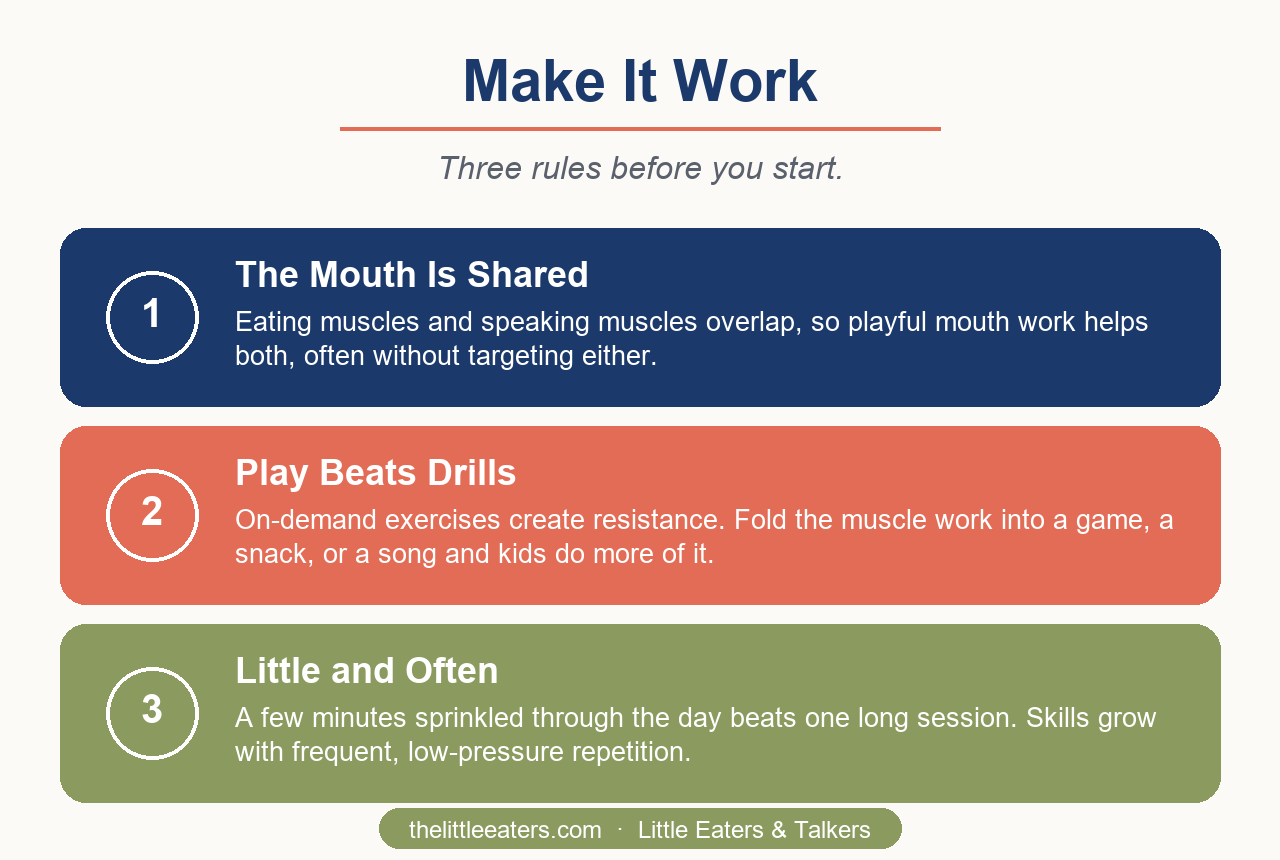
Before the activities, three principles make all the difference in whether this helps or backfires.
The Mouth Is a Shared System
Because the eating muscles and the speaking muscles overlap, playful mouth work is rarely wasted. A child who is blowing bubbles or chewing a crunchy snack is building coordination that shows up in both feeding and speech, often without you targeting either directly.
Play Beats Drills
Isolated exercises done on demand tend to create resistance, especially in young children. The same muscle work folded into a game, a snack, or a song lands far better. If it feels like fun, your child will do more of it, and more practice is what actually builds the skill.
Little and Often
A few minutes woven through the day beats one long session nobody enjoys. Oral motor skills grow with frequent, low-pressure repetition, so aim for small moments sprinkled into normal life rather than a scheduled workout.
Activities to Try at Home
None of these requires special equipment, and all of them are meant to be fun. Follow your child's lead and stop while they are still enjoying it.
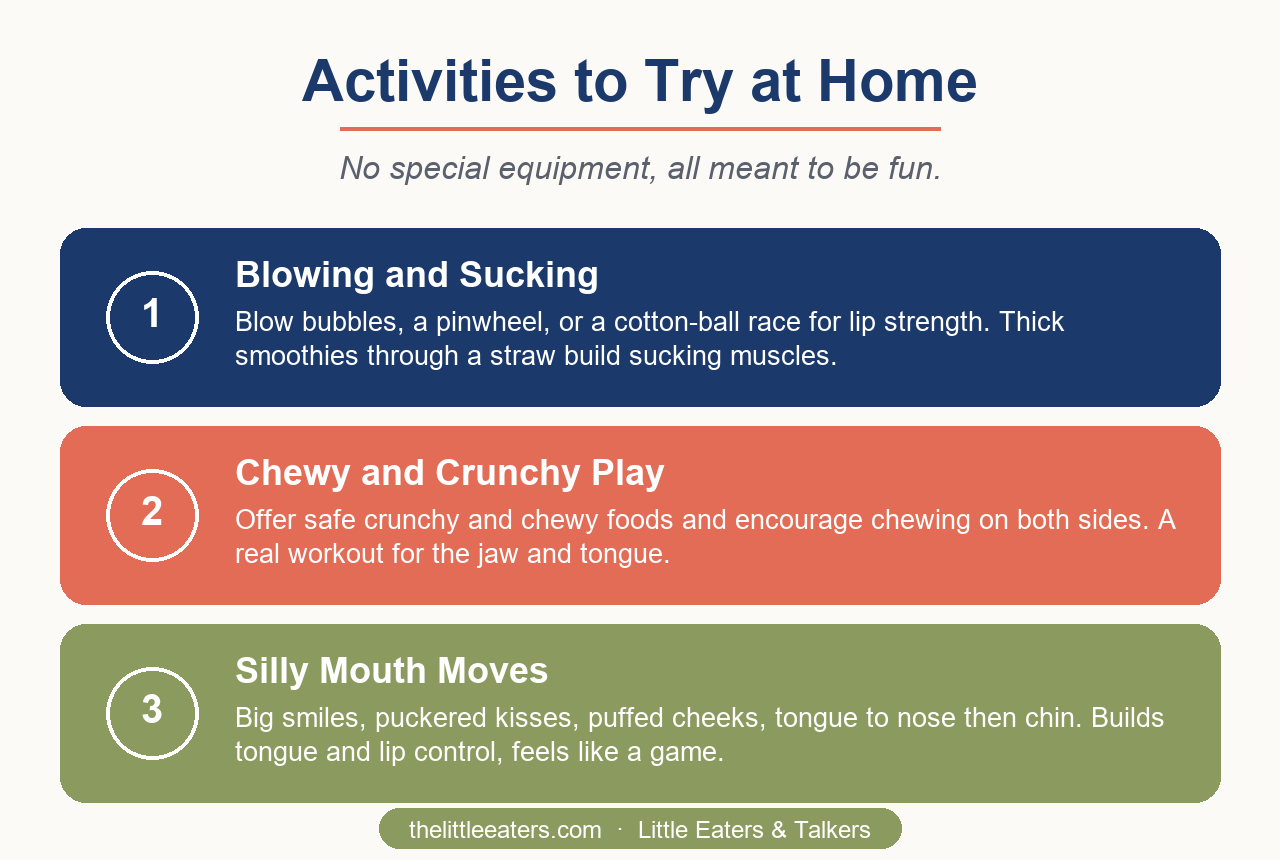
Blowing and Sucking Games
Blowing builds breath control and lip strength. Blow bubbles, blow a cotton ball across the table in a race, blow a pinwheel, or hum kazoos. Sucking builds a different set of muscles, so let your child drink a thick smoothie or yogurt through a straw, which asks the mouth to work harder than an open cup.
Chewy and Crunchy Snack Play
Chewing is oral motor work in disguise. Offer safe, age-appropriate crunchy and chewy foods, and encourage chewing on both sides of the mouth. Foods that take real effort to manage give the jaw and tongue a genuine workout, and they double as a snack.
Silly Mouth Moves and Sounds
Make faces together in a mirror: big smiles, puckered kisses, puffed cheeks, tongue reaching for the nose then the chin. Add silly animal sounds and exaggerated mouth movements. This builds tongue and lip control and awareness, and to your child it is just a giggly game with you.
When to Do More Than Home Play
Home activities are wonderful support, but they are not a substitute for an evaluation when there are real red flags.
If your child is well past the expected age and still struggles to chew, drools heavily, avoids whole texture groups, has speech that is hard to understand, or shows both feeding and speech difficulties together, that is worth a professional look. A feeding and speech specialist can tell you which specific muscles and skills are lagging and give you a targeted plan, and your home play then becomes even more effective.
Frequently Asked Questions
Will these activities fix a speech delay or feeding problem on their own?
They are helpful support, not a cure. For typical development they give a nice boost. For a genuine delay or difficulty, they work best alongside an evaluation and a plan from a specialist, not instead of one.
How often should we do them?
A few short moments a day is plenty, and consistency matters more than length. Two minutes of bubble blowing before snack, a crunchy food at lunch, and silly faces in the mirror at bath time already adds up.
My child refuses when I try to practice. What now?
That usually means it feels too much like a task. Drop the agenda, make it purely playful, join in yourself, and let your child lead. If the resistance is strong across all mouth activities, mention it to a specialist, since it can be its own signal.
Are straws and blowing toys safe for toddlers?
Generally yes, with supervision and age-appropriate items. Stay close, choose sturdy toys without small parts, and stop if your child is unwell or overly tired. When in doubt, check with your provider.
Small Moments Add Up
You do not need to run a clinic at your kitchen table. A few playful minutes a day, folded into snacks and songs and silly faces, genuinely supports the muscles behind both eating and talking.
Our team works with infants and toddlers across Houston and Bellaire on the feeding and speech connection, and we love giving parents the exact activities that fit their child. If eating and talking are both feeling hard, an evaluation will show you where to focus.
Book a consultation with us and we will build a home plan that fits your child.
For more free guidance, visit thelittleeaters.com/FreeDownloads.
Written by The Little Eaters & Talkers Team, a group of pediatric feeding and speech specialists based in Bellaire, TX. We help infants and toddlers navigate feeding challenges, sensory food aversions, and speech development so mealtimes can feel easier for the whole family.