

7 Signs Your Child's Picky Eating Is Actually Sensory (Not Just Stubborn)
7 Signs Your Child's Picky Eating Is Actually Sensory (Not Just Stubborn)
Every parent of a picky eater has heard it: "They'll eat when they're hungry." "They'll grow out of it." "Just keep offering."
Maybe. But sometimes the picky eating isn't about preference or stubbornness. Sometimes there's a sensory processing component that no amount of persistence or variety is going to fix — because the problem isn't the food, it's how the nervous system processes it.
Here are 7 signs I look for in my clinic when I'm assessing whether a child's food selectivity is sensory-based.
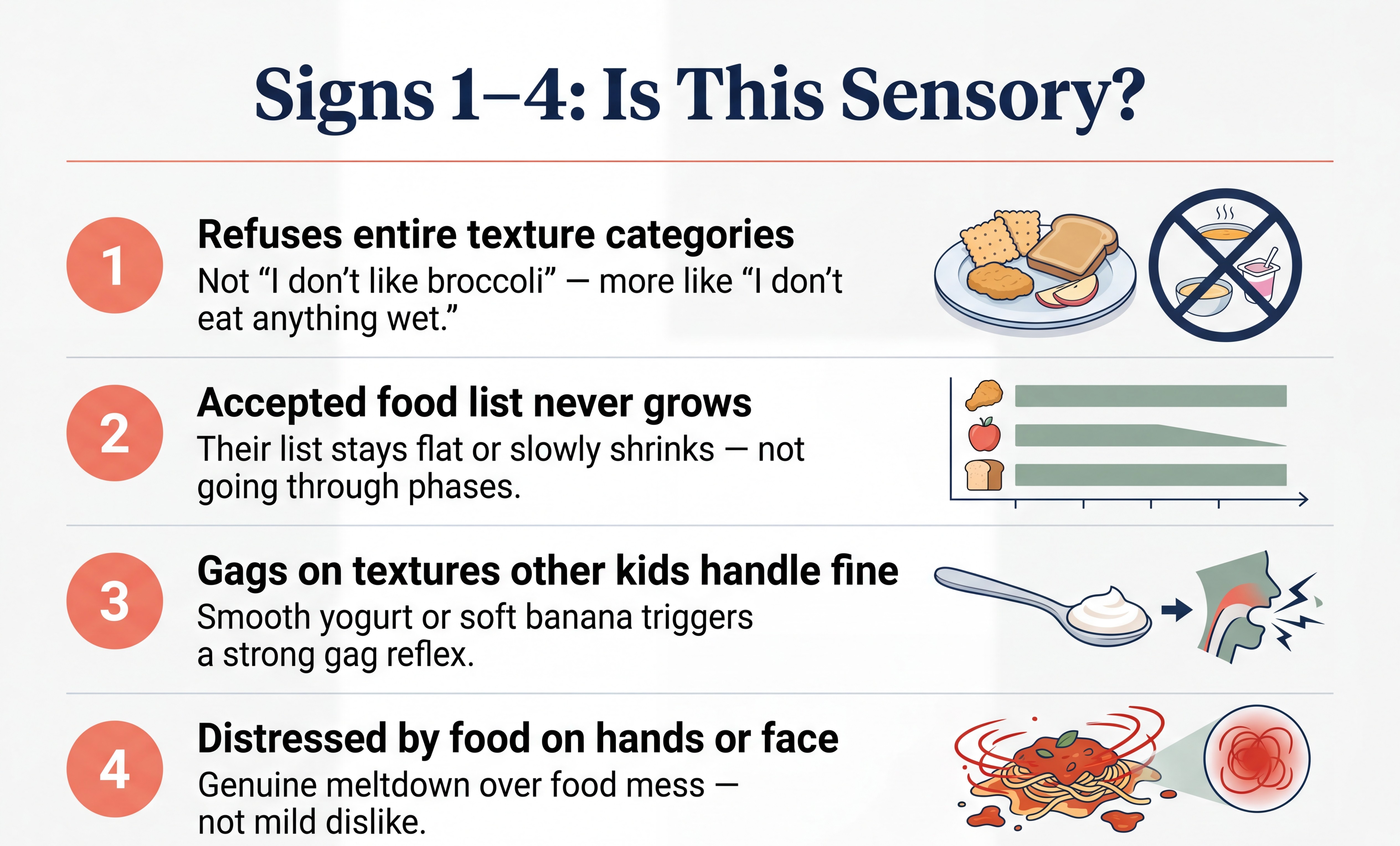
Sign 1: They Refuse Entire Texture Categories
Sensory picky eating isn't usually "I don't like broccoli." It's "I don't eat anything wet," or "I only eat crunchy food," or "nothing that has pieces in it."
When a child avoids an entire texture category rather than specific flavors, that points to sensory processing — not preference. Their nervous system is categorizing foods by sensory property, not taste.
Sign 2: Their Accepted Food List Has Never Grown
A typical picky eater might go through phases — refusing a food for a while, then coming back to it. A child with sensory-based food selectivity often has a list that stays flat or slowly shrinks.
They're not going through phases. They're managing their sensory load, and adding new foods to that load feels genuinely overwhelming.
Sign 3: They Gag on Textures Other Kids Handle Fine
A sensitive gag reflex is often part of the picture. When a child gags on soft banana, smooth yogurt, or any food with even a little texture variation, their oral sensory processing is hypersensitive.
This is different from the normal gagging that happens when babies learn solids. This is a gag reflex that stays hyperactive well into toddlerhood, triggered by things that shouldn't be triggering it.
Sign 4: They're Bothered by Food Getting on Their Hands or Face
When a child has a strong aversive reaction — not just mild dislike, but genuine distress — to food touching their skin, that's a sensory signal.
Children who refuse to touch food, insist on constant wiping, or melt down over food mess are often processing tactile input differently. This same sensitivity often shows up elsewhere: they may dislike tags in clothing, bare feet on grass, or unexpected physical touch.
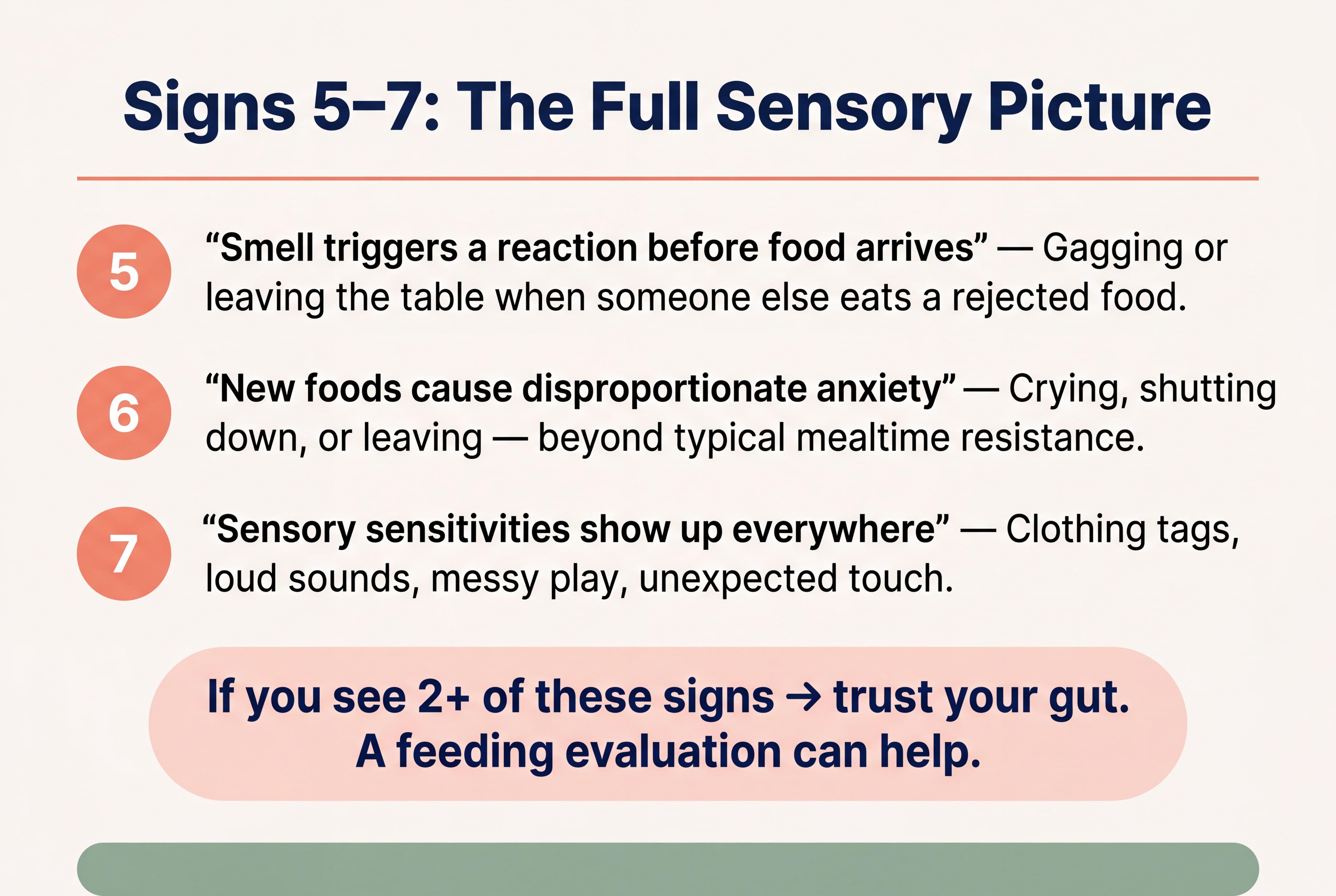
Sign 5: Smell Is a Trigger Before the Food Even Reaches Them
Typical picky eaters might refuse to eat a food. Children with sensory-based food selectivity may react to a food entering the room.
If your child gags, covers their nose, or leaves the table when someone else is eating something they don't eat — that's olfactory hypersensitivity. Their nervous system is registering that smell as a genuine threat.
Sign 6: New Foods Cause Disproportionate Anxiety
When introducing a new food causes significant distress — crying, shutting down, leaving the table, behavioral escalation — that's beyond typical mealtime resistance.
This kind of anxiety says: my nervous system doesn't have a category for this, and that feels dangerous.
Sign 7: Their Sensory Profile Shows Up Elsewhere Too
Sensory-based feeding challenges rarely show up in isolation. Look for these patterns alongside the food issues:
Sensitivity to loud sounds or busy environments
Strong reactions to clothing textures, tags, seams
Difficulty with messy play, finger painting, sand
Heightened reaction to unexpected touch
Difficulty transitioning between activities
What This Means for You
Identifying sensory-based picky eating matters because the intervention is different. "Just keep offering" won't work — and can actually backfire — when the issue is sensory.
Download our Sensory Feeding Parent Guide to start understanding your child's sensory profile at the table.
FAQ
Q: How is sensory picky eating different from regular picky eating?
Regular picky eating tends to involve preference and often improves with repeated neutral exposure over time. Sensory picky eating involves the nervous system — the child's reaction isn't about preference but about how their brain processes sensory input from food. It doesn't improve with exposure alone and often requires feeding therapy.
Q: Can sensory picky eating be a sign of autism?
Sensory-based food selectivity is very common in autistic children, but it also occurs in children without autism. Sensory processing differences exist on a spectrum. A feeding evaluation can help identify what's driving the selectivity regardless of diagnosis.
Q: What does feeding therapy for sensory picky eating look like?
It's gradual, pressure-free, and starts with building sensory tolerance — often starting with touching or smelling a food before any eating is expected. Over time, the nervous system learns the food is safe and eating becomes possible.
Q: My child eats about 10 foods. Is that sensory?
It might be. Ten foods can be enough to maintain nutrition, or it can be a red flag depending on which foods and whether that list is stable or shrinking. A feeding therapist can help assess whether intervention is needed.
If you recognize your child in more than two or three of these signs, trust that instinct.
Sensory-based picky eating is real, it's common, and it's very treatable — especially when you catch it early. Book an evaluation →or call(832)304-3506.
Written by Jean Hawney, M.A., CCC-SLP | Little Eaters & Talkers, Bellaire TX |[email protected]