
Starting Solids: A Houston Feeding Therapist's Simple Guide
Starting solids is one of those milestones that sounds joyful and turns out to be quietly terrifying. One day your baby lives on milk, and the next you are supposed to know when to begin, what to offer, how much, and whether that noise they just made was a gag or a choke.
Take a breath. Starting solids is far simpler than the internet makes it feel, and your baby is more capable than you think. Here is what actually matters, in plain language, from a team that does this every day with Houston and Bellaire families.
When Are Babies Ready for Solids?
Most babies are ready to start somewhere around six months. That is the guideline, and it holds up well.
But age is only half the story. A baby's birthday does not flip a switch. Readiness is really about development, and two babies born the same week can be weeks apart on the things that matter. So rather than counting to a date, watch your own baby for the signs that their body is ready to eat.
Signs Your Baby Is Ready for Solids
It is not just about age. Look for these cues, and look for all three together rather than just one.
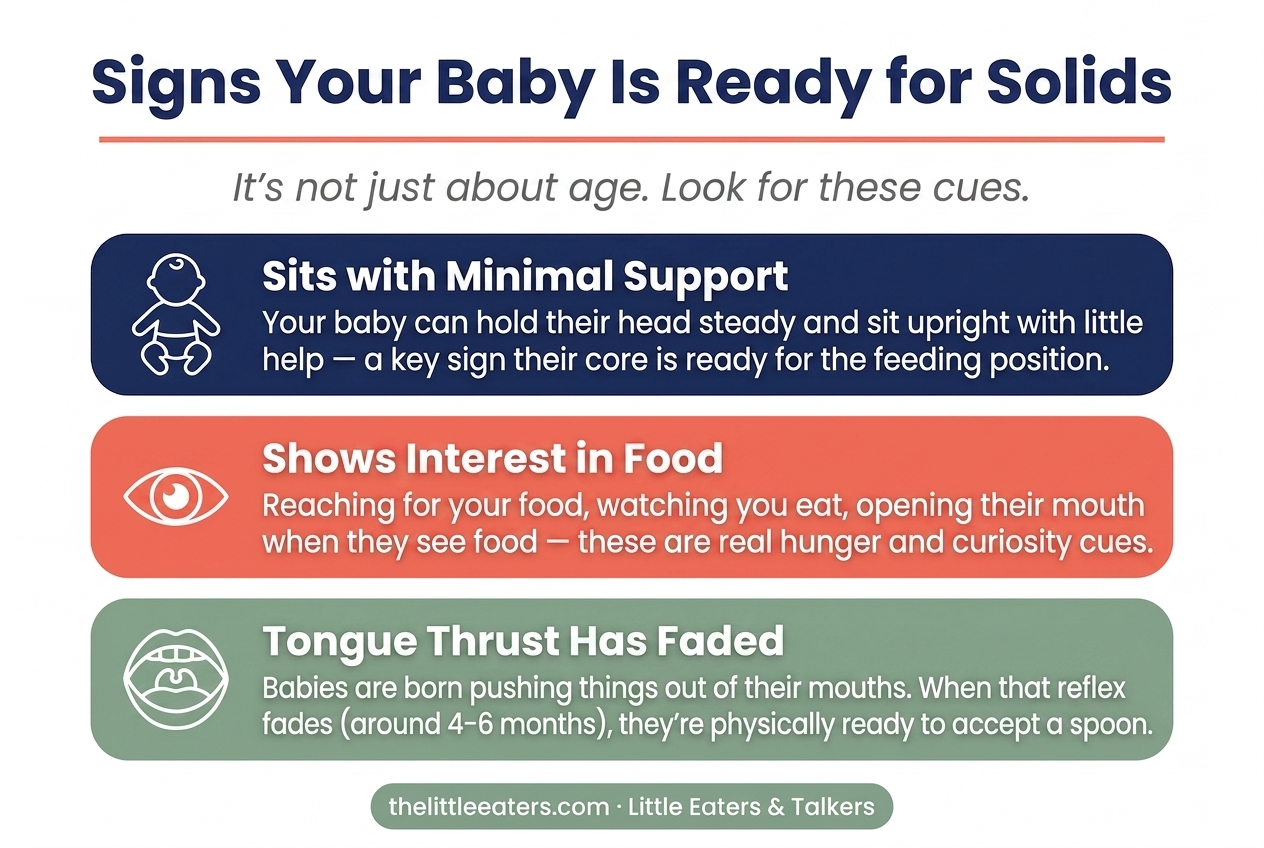
Sits with Minimal Support
Your baby can hold their head steady and sit upright with little help. This is a key sign that their core is ready for the feeding position, and a stable trunk is what lets a baby manage food safely instead of slumping and struggling. If they still need to be propped fully upright, their body is telling you to wait a little longer.
Shows Interest in Food
Reaching for your food, watching you eat, and opening their mouth when they see a spoon coming are all real hunger and curiosity cues. This interest is not just cute, it is motivation, and motivation is half of what makes those first weeks go smoothly.
Tongue Thrust Has Faded
Babies are born pushing things out of their mouths, which is a protective reflex called tongue thrust. When that reflex fades, usually around four to six months, they are physically ready to accept a spoon rather than automatically pushing it back out. If every bite comes straight back at you, the reflex is still doing its job and there is no rush.
Purees or Baby-Led Weaning?
This is the question parents agonize over most, and here is the freeing part. Both approaches work.
Purees let you control texture and pace, which many parents find reassuring at the start. Baby-led weaning lets your baby explore soft finger foods and set their own pace. Plenty of families do a mix, offering purees at some meals and soft finger foods at others. There is no single right answer, and your baby will not be behind either way. Pick the approach that feels manageable to you, because a calm parent matters more than the method.
First Foods: What We Recommend
Simple, safe, and nutrient-rich is the whole brief. You do not need a color-coded meal plan in the first weeks.
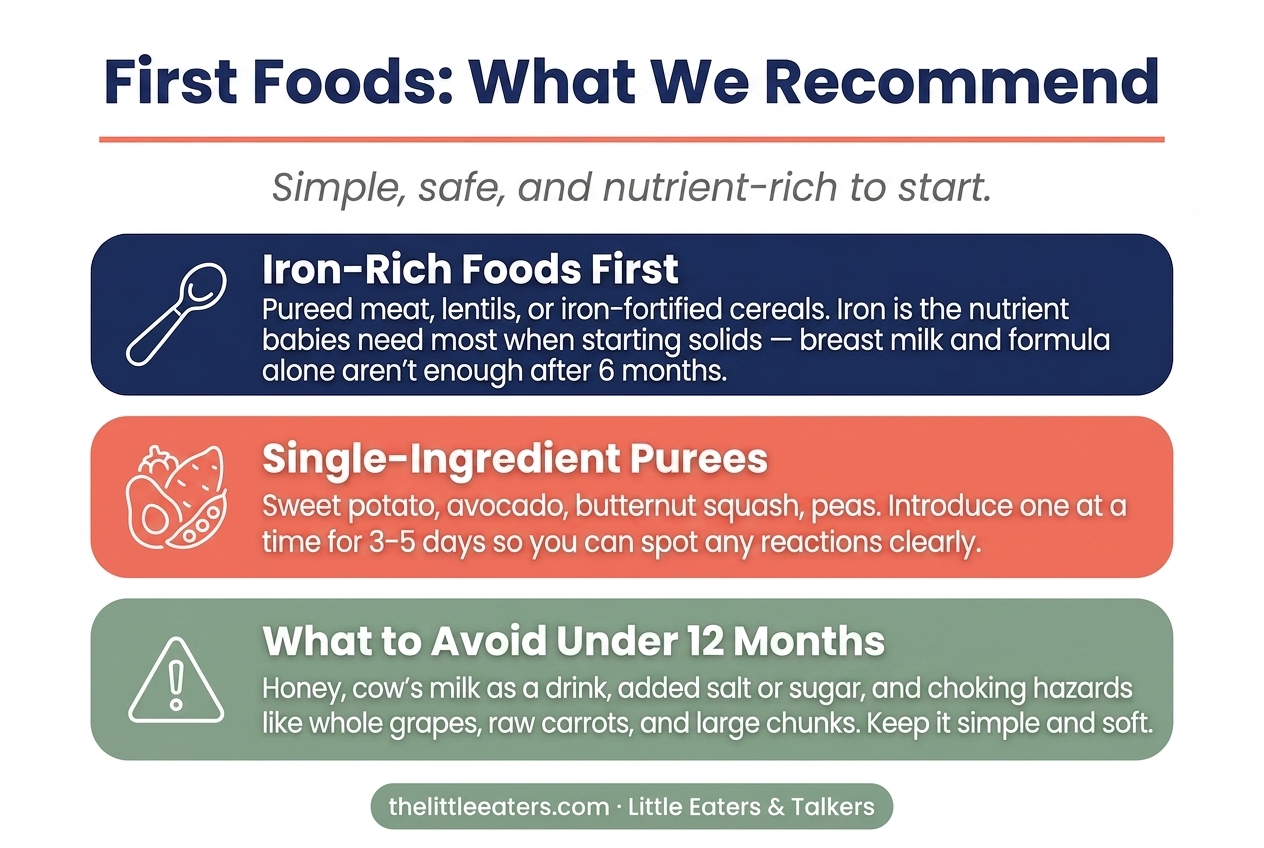
Iron-Rich Foods First
Pureed meat, lentils, or iron-fortified cereals are a strong place to begin. Iron is the nutrient babies need most when starting solids, because breast milk and formula alone are not enough after six months. Leading with iron-rich foods covers the gap that matters most nutritionally, so it is worth making these a regular feature rather than an afterthought.
Single-Ingredient Purees
Sweet potato, avocado, butternut squash, and peas are gentle, well-liked first foods. Introduce one at a time for three to five days each, so if a reaction appears you can spot clearly what caused it. This is also the calmest way to build a baby's early palate, one simple flavor at a time.
What to Avoid Under 12 Months
Skip honey, cow's milk as a drink, and added salt or sugar. Also steer clear of choking hazards like whole grapes, raw carrots, and large chunks. Keep everything simple and soft. Whole grapes should be quartered lengthwise, and hard raw vegetables should be cooked until soft or left off the tray entirely for now.
Gagging Is Not Choking
This is the single thing that scares new parents most, so it is worth understanding before you start.
Gagging is loud, dramatic, and completely normal. It is a protective reflex that moves food forward when it goes too far back, and a gagging baby is coughing, making noise, and often going red in the face while sorting it out themselves. Choking is different, and it is quiet. A choking baby cannot make sound, cough, or cry, because the airway is blocked.
Expect gagging in the early weeks and try to keep your own face calm when it happens, because your baby reads your reaction. Knowing infant CPR and the choking response is a smart thing to have in your back pocket before you begin, the same way you would with any new stage.
How to Make the First Weeks Calm
The goal in the beginning is not volume. It is a baby who feels safe and interested at the table.
Offer solids when your baby is happy and alert, not overtired or ravenous, since a frantic baby cannot learn a new skill. Keep milk as the main source of nutrition for now, because in the early months solids are practice, not a replacement. Let your baby touch, squish, and wear their food, as messy exploration is exactly how they learn a food is safe. And follow their lead on when they are done, rather than chasing one more spoonful, so the table stays a place they want to come back to.
If you would like a simple structure for those first weeks, our free resources page has starting-solids tools that make it easier.
Frequently Asked Questions
Should I start at four months or six months?
Most guidance points to around six months, and to the readiness signs rather than the date alone. Some babies show every sign a little earlier and some a little later. If you are considering starting before six months, it is worth a quick check-in with a professional first, because the readiness signs matter more than the calendar.
How much should my baby actually eat?
In the beginning, almost none, and that is fine. Early solids are about learning the skill of eating, not filling a tummy. A few spoonfuls or a few chewed-and-spat pieces is a completely normal first meal. Intake climbs gradually over weeks as the skill develops.
What if my baby refuses solids completely?
Refusal early on is common and usually just means not yet. Keep mealtimes calm and low pressure, keep offering without forcing, and try again in a few days. If refusal continues for several weeks, or your baby seems to struggle with the mechanics of eating rather than simply losing interest, a feeding evaluation can tell you whether something needs support.
Do I need to introduce allergens?
Current guidance actually encourages introducing common allergens like peanut and egg early and regularly, in age-appropriate forms, rather than delaying them. If your baby has severe eczema or a known food allergy in the family, talk to your pediatrician about the safest way to do this for your child.
You Do Not Have to Get This Perfect
Starting solids is a skill your baby learns over months, not a test you pass or fail in week one. Some meals will be joyful, some will end up mostly on the floor, and both are part of it.
Our team works with infants and toddlers across Houston and Bellaire, and starting solids is one of the most common things families come to us about. If you want a confident start, or your baby is finding those first foods harder than expected, we can help you read what is going on and what to do next.
Book a consultation with us and we will help you begin with confidence.
For more free guidance, visit thelittleeaters.com/FreeDownloads.
Written by The Little Eaters & Talkers Team, a group of pediatric feeding and speech specialists based in Bellaire, TX. We help infants and toddlers navigate feeding challenges, sensory food aversions, and speech development so mealtimes can feel easier for the whole family.