

What to Say to Your Pediatrician About Your Child's Eating
You have a fifteen-minute appointment. Your child has been on your mind for weeks. You mention that they are a bit of a picky eater, the pediatrician nods, says most kids go through it, and the visit moves on to the next thing.
You leave feeling like you did not quite say what you meant, and nothing changed.
This is one of the most common frustrations parents bring to us. Not that their pediatrician is wrong, but that the concern never quite lands. The good news is that this is fixable, and it comes down to how you raise it.
Why the Conversation Often Falls Flat
Pediatricians are generalists managing an enormous amount in very little time. Growth, development, illness, vaccines, sleep, behavior, all of it, in a slot that barely stretches to fifteen minutes.
Feeding disorders are a subspecialty. Most pediatricians have limited training in them, which is not a criticism, it is simply the scope of the job. So a vague mention of picky eating gets sorted into the enormous pile of things that usually resolve on their own, because most of the time it does.
Your job in that room is to signal, clearly, that this is not the usual kind. Specific concerns get taken seriously. Vague worry gets reassurance.
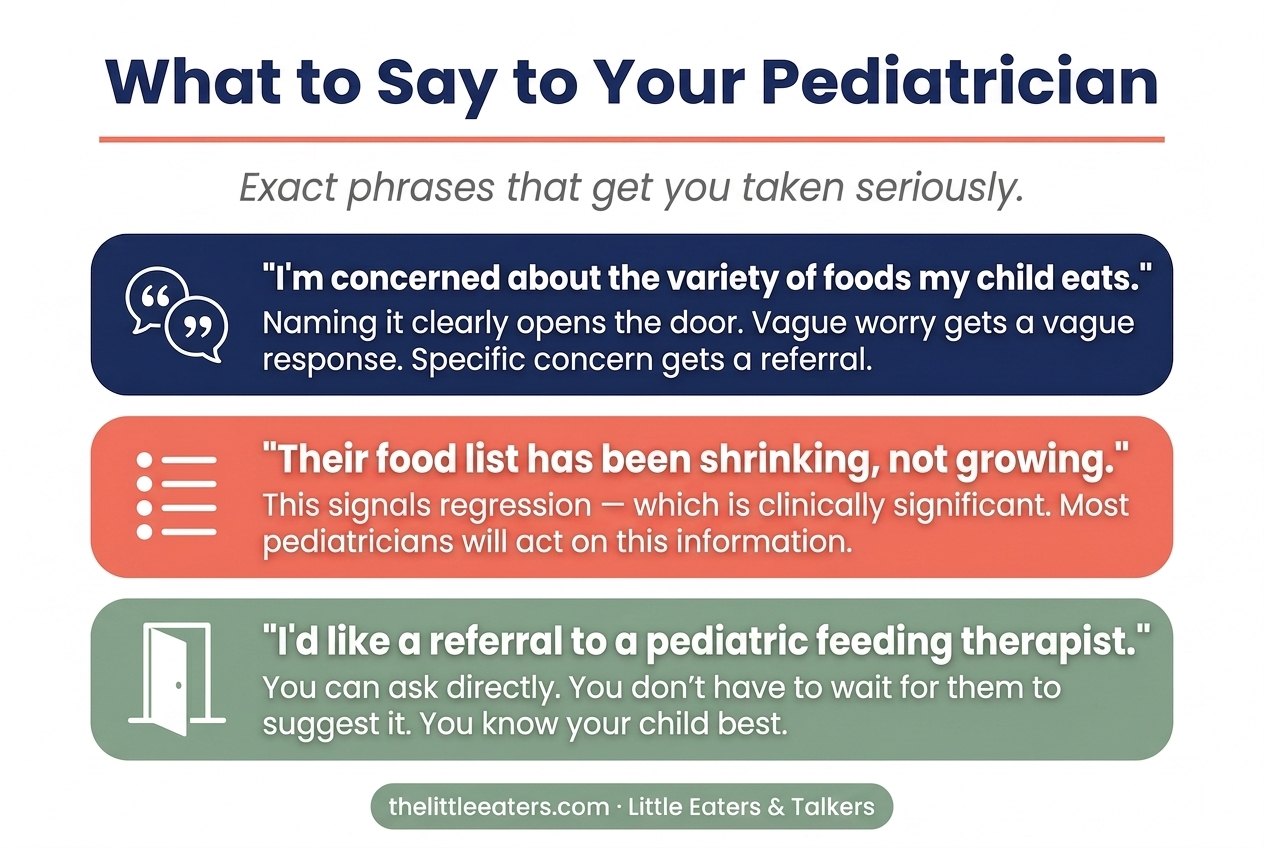
What to Say to Your Pediatrician
These are the exact phrases that get you taken seriously. Say them plainly.
"I'm concerned about the variety of foods my child eats."
Naming it clearly opens the door. Vague worry gets a vague response. Specific concern gets a referral. The word variety matters, because it points at the thing feeding therapists actually assess, rather than at whether your child ate their dinner last night.
"Their food list has been shrinking, not growing."
This one sentence signals regression, which is clinically significant, and most pediatricians will act on it. A child who is slowly dropping foods rather than adding them is showing a pattern that typical picky eating does not follow. If this is true for your child, lead with it.
"I'd like a referral to a pediatric feeding therapist."
You can ask directly. You do not have to wait for them to suggest it. You know your child best, and asking for the referral by name moves the conversation from should we worry to here is the next step.
Come With Specifics, Not Impressions
The single most useful thing you can bring is data, because it turns your gut feeling into something a clinician can act on.
Instead of "she's really picky," try "she eats about eight foods, all of them soft or crunchy, nothing in between, and she's dropped three foods in the last two months." Instead of "he gags a lot," try "he gags at almost every meal that includes lumps, and twice this week it ended in vomiting."
If you have tracked meals for even a few days, bring the notes. A short written record does more to move a pediatrician than any amount of describing, and it protects you from the moment where your child eats perfectly in the waiting room and your worry suddenly sounds overblown.
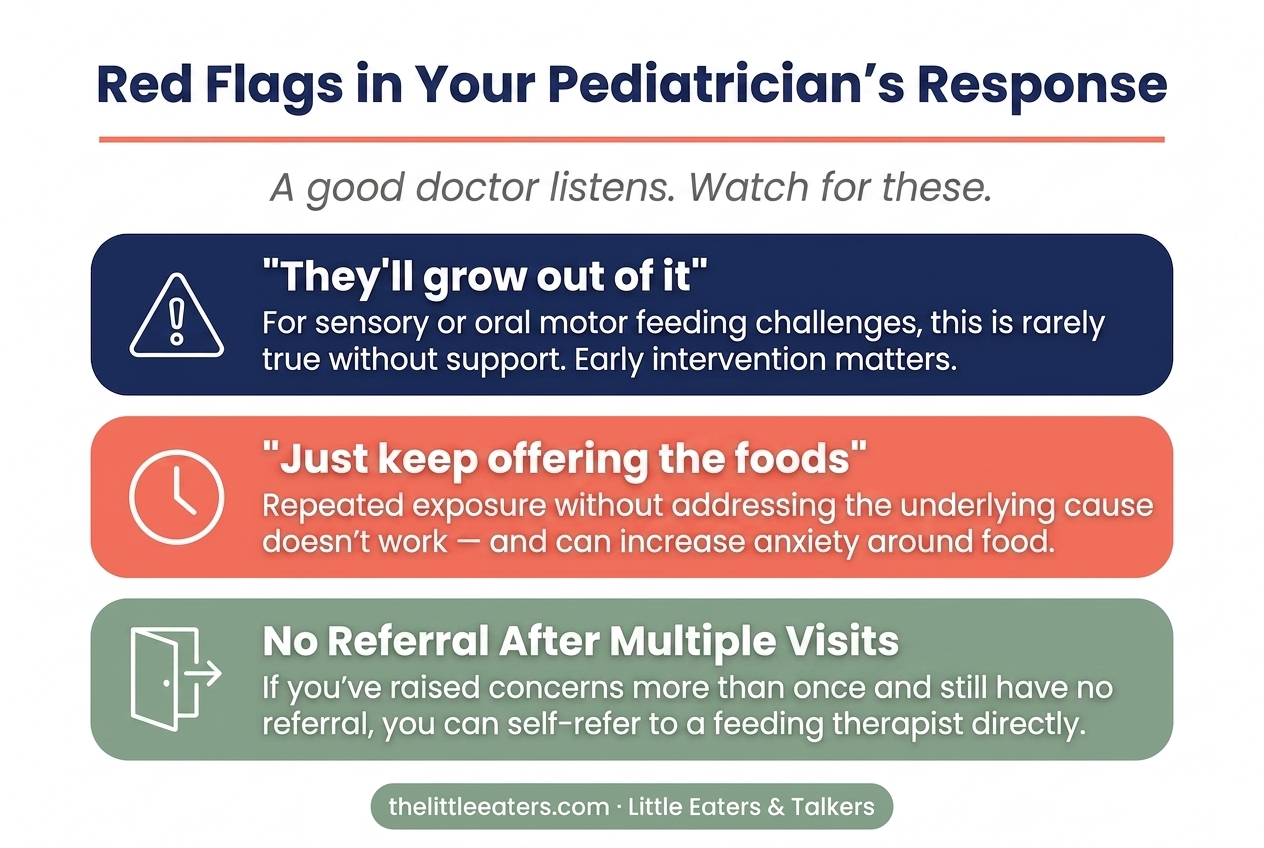
Red Flags in Your Pediatrician's Response
A good doctor listens. Most do. But if you have raised a genuine concern and get one of these, it is worth knowing what it means.
"They'll grow out of it."
For sensory or oral motor feeding challenges, this is rarely true without support. Early intervention matters, and the gap tends to widen while you wait. Some children do grow out of ordinary fussiness. Children with an underlying feeding difficulty usually do not, because the difficulty is not about willingness.
"Just keep offering the foods."
Repeated exposure without addressing the underlying cause does not work, and it can increase anxiety around food. Exposure is part of feeding therapy, but only once you understand why a child is refusing. Offering a threatening food fifty more times, with no change to why it feels threatening, tends to deepen the avoidance rather than ease it.
No referral after multiple visits.
If you have raised concerns more than once and still have no referral, you can self-refer to a feeding therapist directly. In Texas you do not need a physician's referral to be seen for a feeding evaluation, so a stalled conversation does not have to stall your child's support.
Advocating Without Feeling Like a Difficult Parent
Many parents hold back because they do not want to seem pushy, or to imply the doctor is missing something. That instinct is understandable, and it is worth setting aside here.
Asking for a feeding evaluation is a normal, reasonable request. You are not overriding your pediatrician, you are adding a specialist to the team for the one area that sits outside their day-to-day scope. A good pediatrician welcomes that, in the same way they would refer to a cardiologist or a dermatologist without it being a slight on their own expertise.
You know your child in a way fifteen minutes cannot capture. That knowledge is not a nuisance in the room. It is the most valuable thing in it.
Frequently Asked Questions
What if my pediatrician disagrees that it's a problem?
You can still seek an evaluation. A feeding therapist assesses things a general check-up does not, and the evaluation itself will tell you whether there is a real concern. If your gut says something is off, an hour with a specialist is a reasonable way to find out.
Do I really need a referral to see a feeding therapist?
In Texas, no. You can self-refer for a feeding evaluation without a physician's referral. A referral can help with insurance paperwork, but it is not required to be seen.
How do I bring it up without offending my doctor?
Frame it as adding support, not correcting them. "I'd like to loop in a feeding specialist for this part" is collaborative and clear, and most pediatricians respond well to it.
What should I track before the appointment?
Roughly three days of meals, noting foods accepted, foods refused, any gagging or distress, and whether the list of accepted foods is growing or shrinking. That is enough to make your concern concrete.
You Are Allowed to Push for Answers
If a conversation with your pediatrician has left you unsure, that uncertainty is worth resolving rather than sitting with. Being told to wait is not the same as being told everything is fine.
Our team works with families across Houston and Bellaire, and part of what we do is give you a clear, honest read on whether your child needs support and what kind. You are welcome to come to us directly, referral or not.
Book a consultation with us and we will take a proper look together.
For more free guidance, visit thelittleeaters.com/FreeDownloads.
Written by The Little Eaters & Talkers Team, a group of pediatric feeding and speech specialists based in Bellaire, TX. We help infants and toddlers navigate feeding challenges, sensory food aversions, and speech development so mealtimes can feel easier for the whole family.