

Why Your Toddler Only Eats Beige Food (And What Actually Helps)
Chicken nuggets. Plain pasta. Crackers. Toast. Maybe a pouch. If your toddler's diet looks like a study in beige, you have almost certainly been told to just keep offering colorful foods and wait it out.
For some kids, that works. For a sensory-sensitive child, it usually does not, and hearing it one more time is exhausting. Here is what is actually going on when a child lives on beige food, and what genuinely helps.
Your Child Is Not Choosing Carbs. Their Nervous System Is.
Beige foods are not just tasty. They are predictable. A cracker is the same every single time: same color, same crunch, same smell, no surprises.
For a child whose sensory system reads the world at high volume, that predictability is safety. A strawberry, by contrast, is a sensory gamble. It might be soft or firm, sweet or sour, seedy on the outside, wet in the middle. To a sensitive nervous system, that unpredictability can feel genuinely unsafe, not merely unappealing.
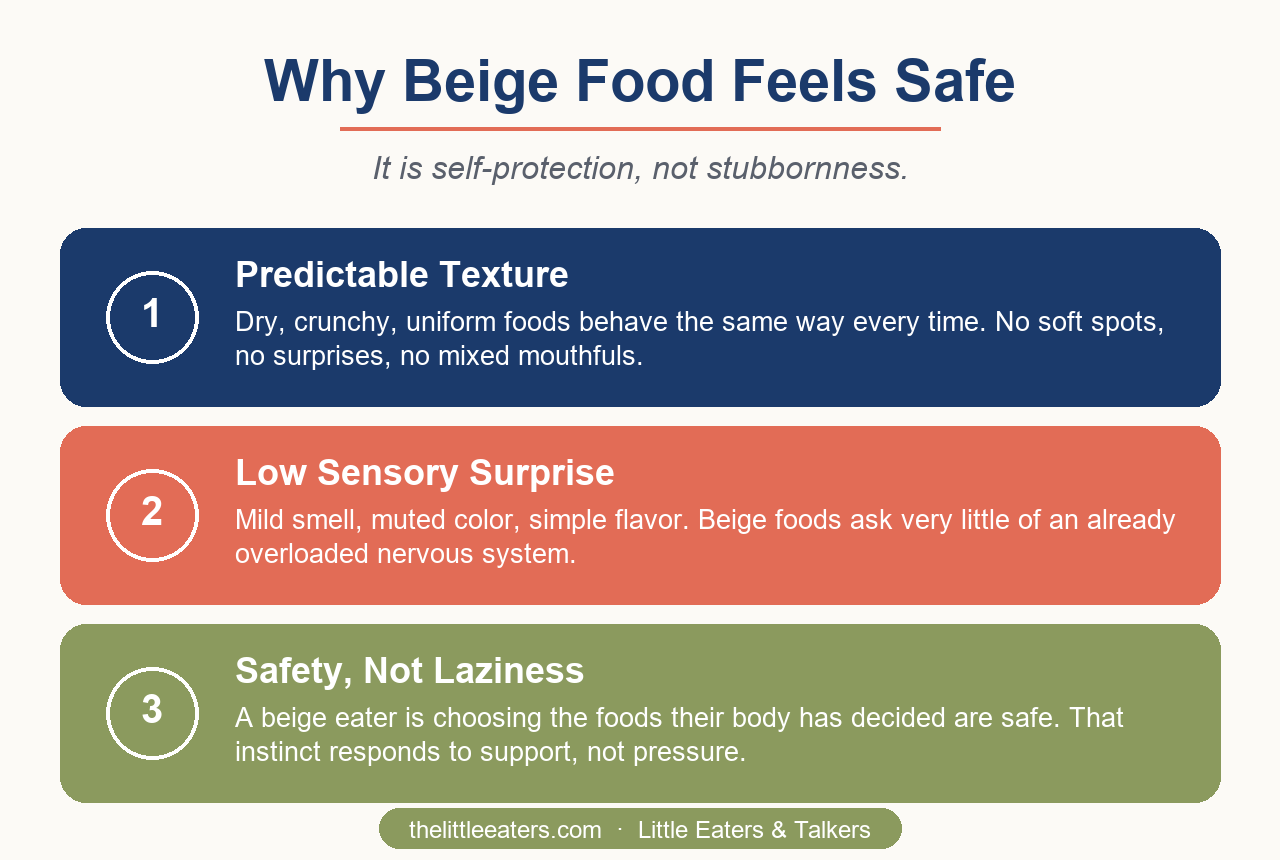
Why Beige Food Feels Safe
When you understand what a beige food offers a sensitive child, the whole picture shifts from stubbornness to self-protection.
Predictable Texture
Dry, crunchy, and uniform textures behave the same way every time. There is no soft spot, no sudden squish, no mixed mouthful. For a child who finds unexpected textures alarming, that consistency is the whole appeal.
Low Sensory Surprise
Beige foods tend to be mild in smell, muted in color, and simple in flavor. They ask very little of an overloaded system. A brightly colored, strong-smelling, wet food asks a great deal all at once.
Safety, Not Laziness
This is the part that matters most. A child eating only beige foods is not being difficult or lazy. They are choosing the foods their nervous system has decided are safe. That is a protective instinct, and it responds to support, not pressure.
Preference or Sensory Need?
There is a real difference between a child who prefers beige foods and one who needs them, and it changes what you do next.
A preference is flexible. A child with a preference might grumble about broccoli but eat it when they are hungry enough, and will branch out with gentle, low-pressure exposure over time.
A sensory need is not flexible in the same way. This child does not avoid the strawberry because they are holding out for something better. They avoid it because their body is telling them it is not safe to put in their mouth. No amount of hunger overrides that, which is exactly why the usual advice falls flat.
Why "Just Keep Offering It" Backfires
Repeated exposure is part of feeding therapy, but only when it happens without pressure. Here is the trap.
When you put a threatening food on the plate again and again, with the unspoken expectation that today is the day they eat it, you are not building safety. You are repeating the stress. Every tense meal teaches the child that the table is a place where they are pushed toward foods that feel unsafe, and avoidance gets stronger, not weaker.
The food is not the problem to solve first. The feeling of safety is.
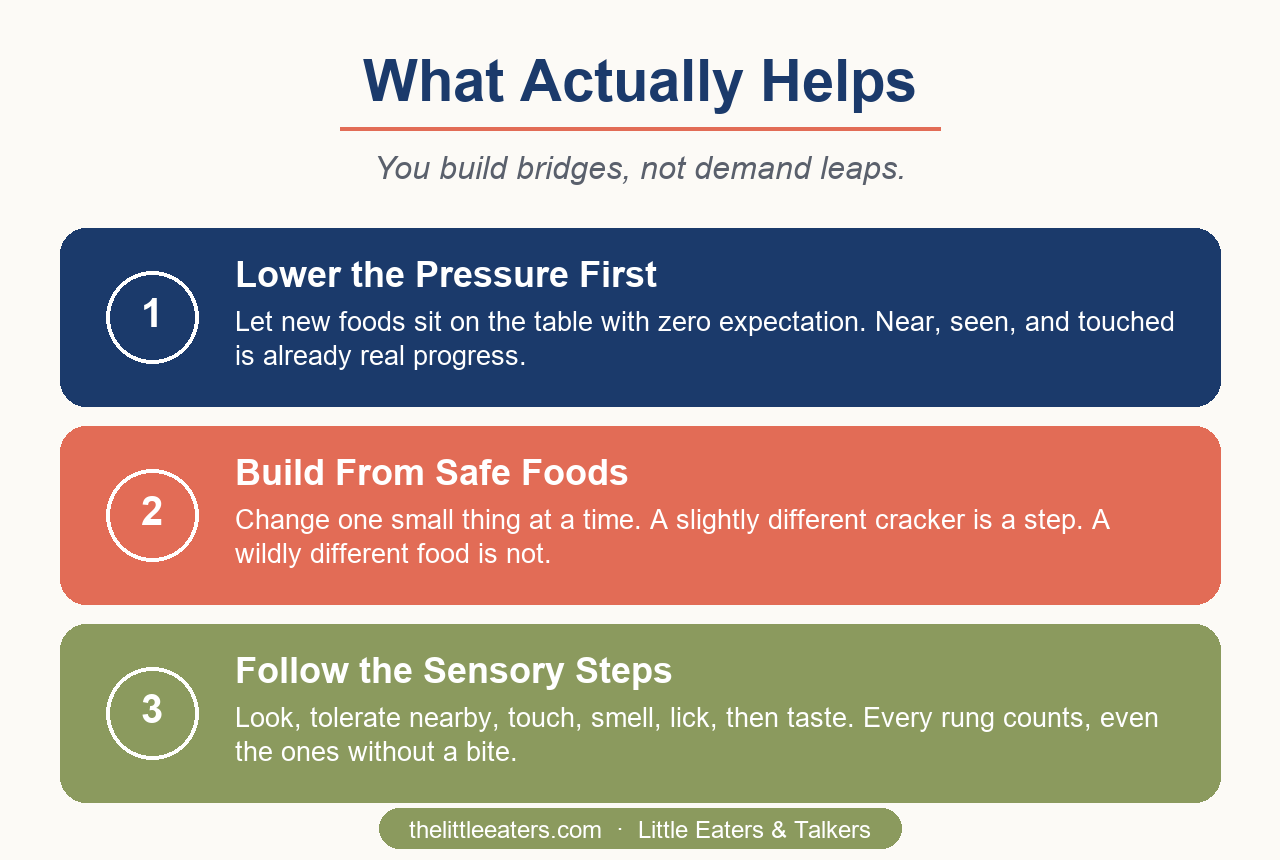
What Actually Helps
You expand a beige diet by building bridges, not by demanding leaps.
Lower the Pressure First
Before anything else, take the pressure off. Let new foods sit on the table with zero expectation that they be eaten. A child who is allowed to simply be near a food, look at it, and touch it is a child whose nervous system is slowly learning that food is not a threat.
Build From What They Already Accept
Start with a safe food and change one small thing at a time. If your child eats one brand of plain cracker, a slightly different cracker is a small, manageable step. A wildly different food is not. Small, close changes keep the food inside the zone of safe.
Follow the Sensory Steps
Trying a new food is not one leap from never to eaten. It is a ladder: looking at it, tolerating it nearby, touching it, smelling it, licking it, and only much later tasting it. Every rung is real progress, even the ones that do not end in a bite.
Frequently Asked Questions
Will my child grow out of only eating beige food?
Some children do broaden their diets on their own. For a genuinely sensory-driven eater, the pattern usually does not fade on its own, because avoidance tends to deepen while it goes unaddressed. Support tends to be faster and far less stressful than waiting.
Is a beige diet nutritionally dangerous?
It depends on the range and on your child's growth. Many beige eaters get by nutritionally in the short term, but a shrinking list, weight or growth concerns, or a very small number of accepted foods are all reasons to have a feeding evaluation rather than wait.
Should I hide vegetables in the foods they like?
Sneaking can help nutrition in the moment, but on its own it does not teach a child to eat new foods, and if they discover it, it can damage the trust that makes the table feel safe. It works best alongside open, pressure-free exposure, not instead of it.
How many foods is too few?
Most toddlers eat somewhere around twenty to thirty foods. Below twenty, especially if the list is shrinking, is worth evaluating, and quality matters as much as the number, since a child eating twenty foods that are all the same texture can still have a real difficulty.
You Are Not Failing at This
If mealtimes have become a quiet source of dread, that is not a sign you are doing it wrong. Feeding a sensory-sensitive child is genuinely harder, and the standard advice was not built for your kid.
Our team works with families across Houston and Bellaire on exactly this, sensory food aversions and the beige-food plateau, and we start by figuring out whether this is a preference or a sensory need and building from there.
Book a consultation with us and we will help you make the table feel safe again.
For more free guidance, visit thelittleeaters.com/FreeDownloads.
Written by The Little Eaters & Talkers Team, a group of pediatric feeding and speech specialists based in Bellaire, TX. We help infants and toddlers navigate feeding challenges, sensory food aversions, and speech development so mealtimes can feel easier for the whole family.