

Why Autistic Children Struggle with Eating
If you're raising an autistic child, you already know that mealtimes can feel like the hardest part of the day.
Not because your child is being difficult. Not because you're doing it wrong. But because eating is one of the most sensory-loaded, unpredictable, overwhelming experiences a child can have — and for autistic kids, that's amplified in ways most people never see.
I work with autistic children and their families every week at Little Eaters & Talkers. I want to talk plainly about what's actually going on at the table and what genuinely helps.
What Autism Has to Do with Eating
Autism affects how the brain processes sensory information. That includes taste, smell, texture, temperature, and even the visual appearance of food.
For an autistic child, a piece of chicken that looks slightly different than yesterday's chicken is not the same food. A vegetable that touched another food on the plate is contaminated. A crunchy food that suddenly becomes soft in the mouth is terrifying.
This isn't pickiness. This is a nervous system that is working overtime to process a world full of unpredictable sensory input — and food is one of the most unpredictable things there is.
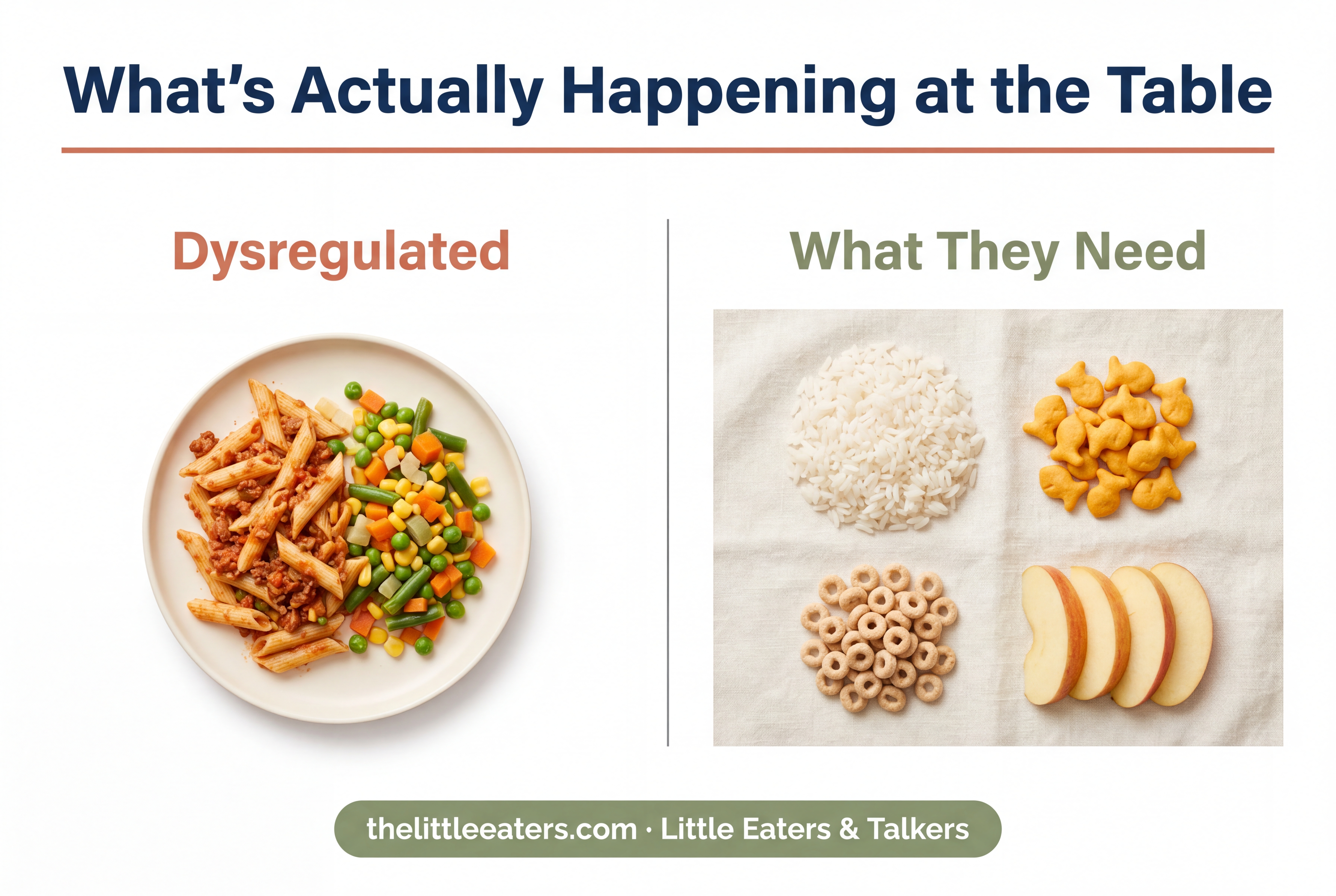
When an autistic child refuses food, gags, melts down, or will only eat 5 specific foods, they are not being manipulative. They are dysregulated.
Dysregulation means their nervous system is overwhelmed and cannot safely engage with something new. Eating requires a level of calm and safety that dysregulation makes impossible.
This is why pressure at the table makes things dramatically worse. When a child is already overwhelmed and then feels pushed, the nervous system goes into protection mode. Food becomes associated with stress. The accepted food list gets shorter, not longer.
What autistic kids need before they can try new food is regulation — a calm body, a predictable environment, zero pressure, and a parent who isn't visibly anxious about what they eat.
That's easier said than done. I know.
Why the Accepted Food List Gets So Short
Most autistic children have what's called a "safe food" list — the 5, 8, maybe 10 foods they will reliably eat without distress.
Safe foods are often:
Beige, brown, or uniform in color
Crunchy or completely smooth (no in-between textures)
Predictable in taste and appearance every single time
From specific brands (because the same food from a different brand tastes different to them)
The problem is that this list tends to shrink over time when families are in survival mode — just getting food in — without a plan for expanding it. That's not a failure. That's what happens when you're exhausted and you don't have support.
Download our freeSensory Feeding Guidefor a starting point on expanding safe foods without pressure.
What Feeding Therapy Looks Like for Autistic Kids
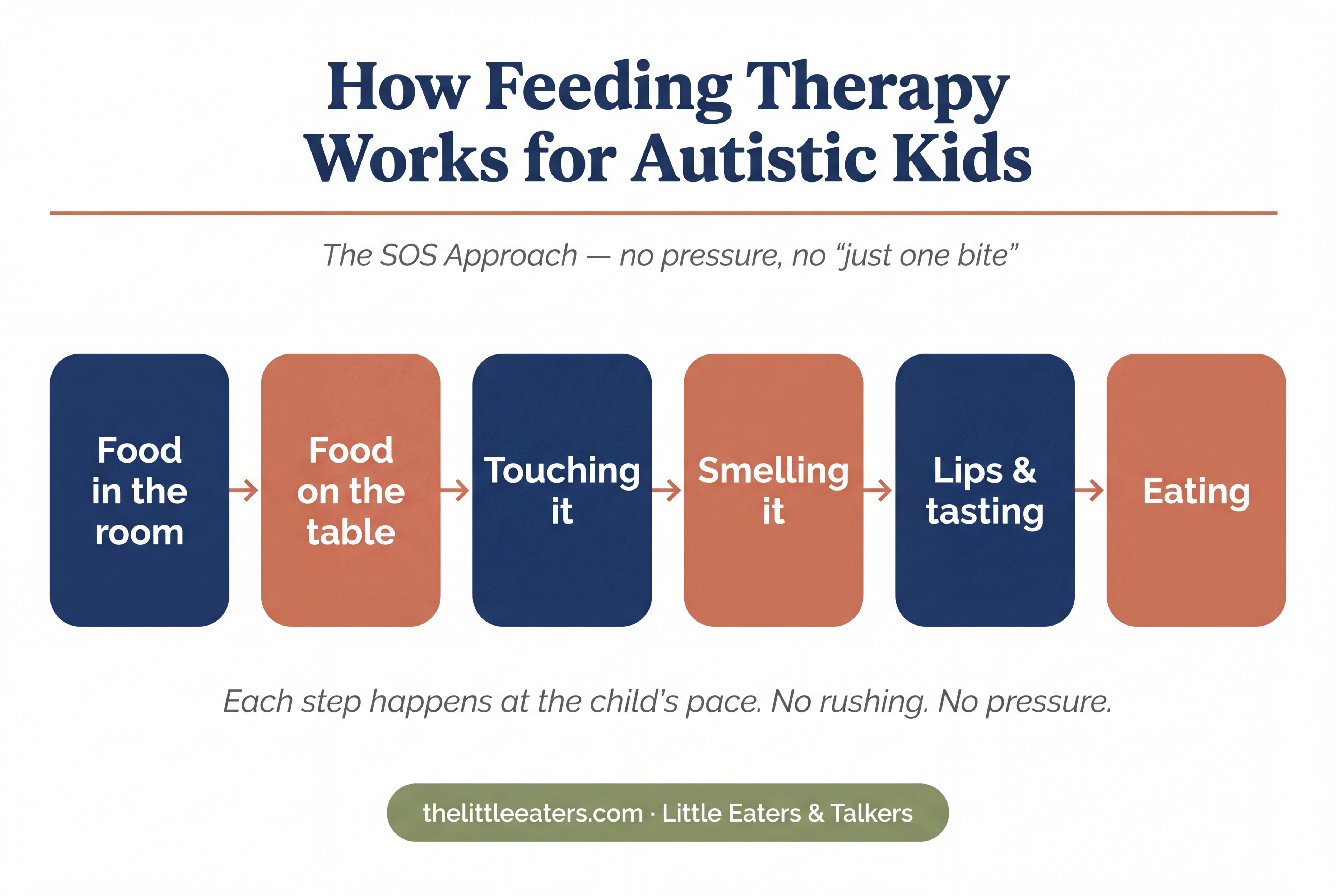
Feeding therapy for autistic children looks nothing like "just try one bite." That approach causes harm. Trauma around food makes the problem worse, not better.
What actually works is a sensory-based, pressure-free approach that builds on the child's existing safe foods and gradually introduces new sensory experiences — starting nowhere near the mouth.
We might start with:
Touching a new food with one finger
Smelling it from across the table
Letting it sit on the tray without any expectation
Playing with it — mashing, pushing, moving it around
Watching a parent eat it with no comment
Over time — and this takes time — the nervous system learns that this new food is safe. That's when eating becomes possible.
The "Wait and See" Problem
One of the hardest parts of my job is seeing families who were told to wait and see at 18 months and are now sitting in my office with a 5-year-old who eats 4 foods.
Feeding challenges in autistic children do not resolve on their own. They tend to narrow. Early support matters enormously — not because something is "wrong" with your child, but because the window for building food flexibility is widest when children are young.
If something feels off, trust that instinct.
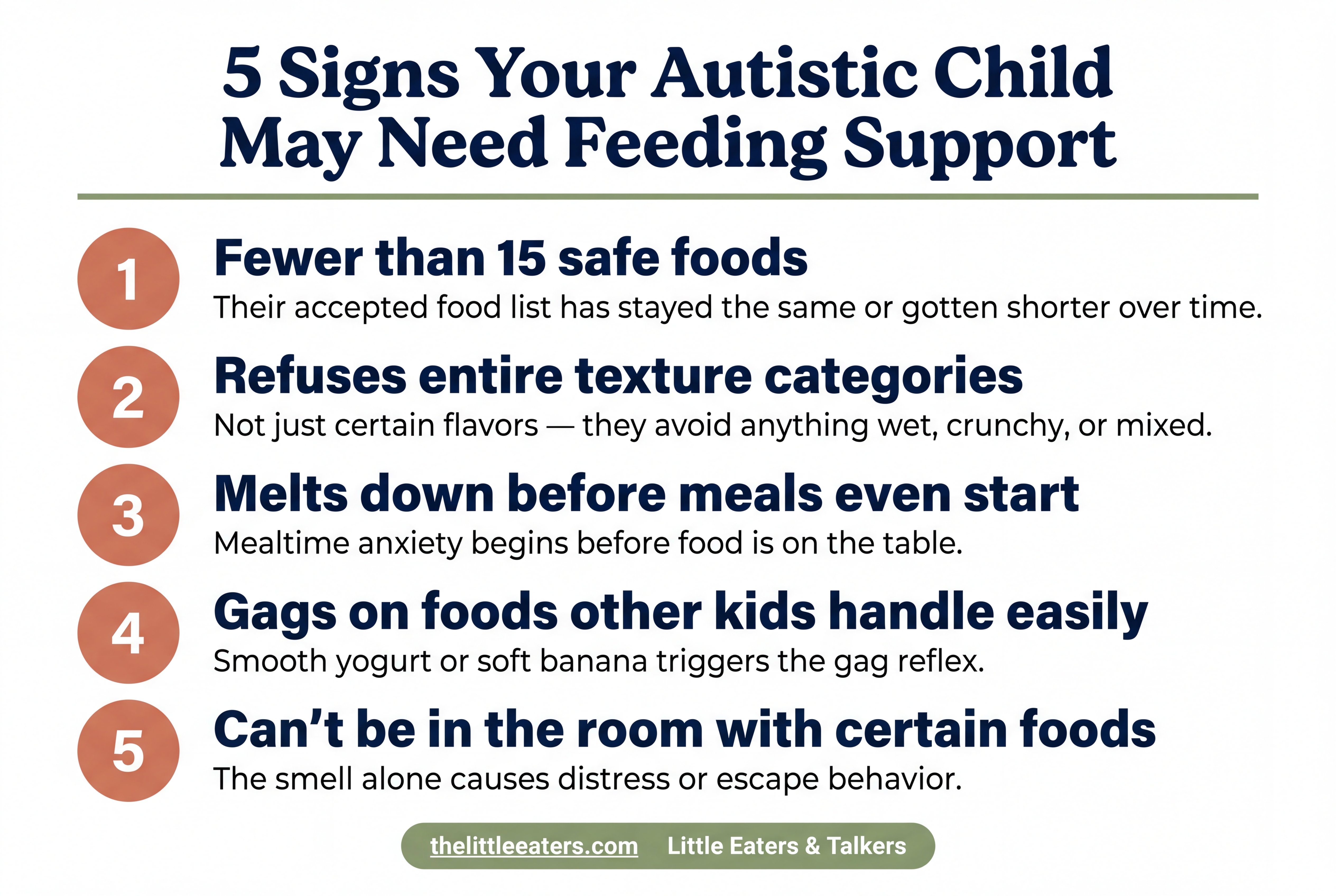
Consider reaching out for a feeding evaluation if your autistic child:
Eats fewer than 15–20 different foods
Has a list that's been shrinking, not growing
Gags or vomits frequently during meals
Cannot be in the same room as certain foods
Has significant meltdowns at mealtimes most days
Is losing weight or showing signs of nutritional gaps
FAQ
Q: Is picky eating a sign of autism?
Extreme food selectivity — eating fewer than 20 foods, refusing entire food groups, gagging at the sight or smell of food — can be one sign of autism, but it's also present in children without autism. A feeding evaluation can help identify what's driving the selectivity.
Q: What is the best feeding therapy approach for autistic children?
A sensory-based, pressure-free approach like the Sequential Oral Sensory (SOS) approach works well for most autistic children. It builds food tolerance gradually through play and exploration before any eating is expected.
Q: My autistic child will only eat 5 foods. Is this dangerous?
It can become a nutritional concern over time, especially for growing children. The urgency depends on which foods and what nutrients are missing. A feeding therapist can assess this and work on expanding the safe food list safely.
Q: Can feeding therapy make autism-related eating worse?
The wrong kind of therapy — anything that uses pressure, force, or "just one bite" — can absolutely make things worse. The right kind of therapy, run by a qualified feeding specialist, should always feel safe for the child.
Q: At what age should I seek feeding therapy for my autistic child?
As soon as you notice a concern — even in toddlerhood. There is no "too early." Early intervention gives children the best chance at building food flexibility before habits are deeply ingrained.
I want every parent of an autistic child to know: you are not failing at mealtimes. Your child is not failing. Their nervous system is doing exactly what it's built to do.
With the right support, mealtimes can get easier. I've seen it happen hundreds of times.
If you want to talk through what you're seeing at your table, I'm here. Book a free consultation →or call us at (832)304-3506.
Written by Jean Hawney, M.A. CCC-SLP
Jean is a pediatric feeding specialist and speech-language pathologist at Little Eaters & Talkers in Bellaire, TX. She works with infants and toddlers — including many autistic children — to make mealtimes safer, calmer, and less stressful for the whole family.
Book a consultation →|(832)304-3506|[email protected]